

Tennessee has made significant progress on teacher pay. We should acknowledge it. The state has steadily raised the minimum teacher salary, reaching $50,000 for the 2026–27 school year — especially meaningful for rural and smaller systems that cannot simply draw more from their local tax base.
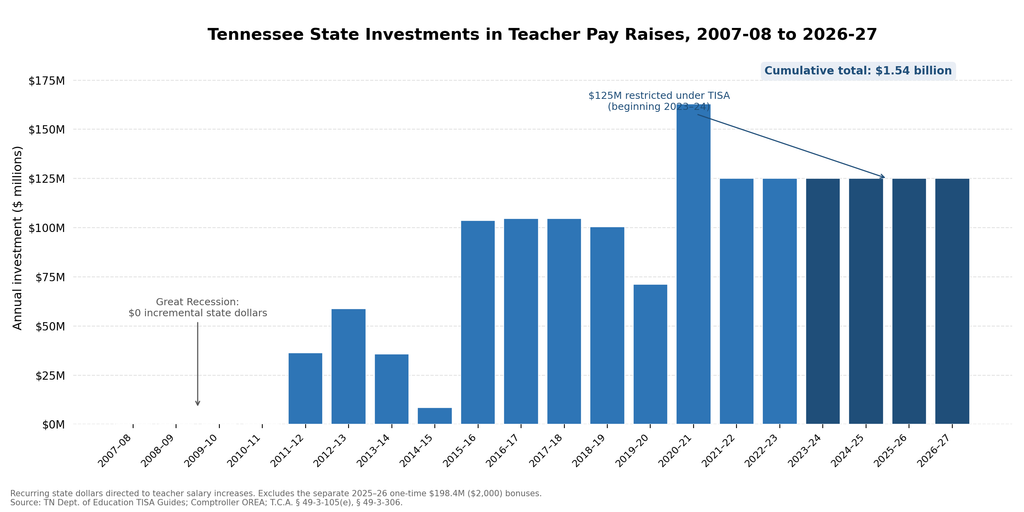
Tennessee has directed $1.54 billion in recurring teacher-pay investments from 2007–08 through 2026–27. After three recession years with $0 in annual investments, investments rose sharply in the mid-2010s and have held at $125 million a year since 2022–23 — restricted under TISA beginning in 2023–24. That figure excludes the separate $198.4 million in one-time $2,000 bonuses in 2025–26. Have we kept up with neighboring states or with the rate of inflation? Not always. But there is no dispute that Tennessee has made a concerted effort to raise teacher salaries.
The Tennessee Department of Education reports the average classroom teacher salary reached $60,784 in 2024–25. These are meaningful gains. But raising the floor cannot be the end of Tennessee’s teacher compensation strategy. The next question is harder: Are we directing compensation dollars where they have the greatest impact on recruiting and retaining good teachers?
Different communities face different problems. A rural district struggling with starting salaries does not face the same challenge as Nashville, where housing costs hit young professionals hardest. Neither faces the same problem as a district hunting for special education, ESL, math, or science teachers. One salary schedule cannot solve every workforce problem.
Tennessee teachers are telling us something important: compensation matters, but it alone does not determine whether they stay. Nearly 42,000 educators participated in the 2025 Tennessee Educator Survey, and more than 80 percent said they planned to continue teaching in their schools the following year — citing strong leadership and staff culture as key reasons. Among those planning to leave, personal reasons were cited most frequently, followed by school leadership and school culture.
That should influence public policy. Pay may help get teachers through the door. Working conditions help determine whether they stay. You can’t recruit your way out of a retention problem.
Tennessee needs a more strategic compensation system. Start with shortage areas. Special education remains particularly difficult to staff, as do ESL and certain math and science positions. A small stipend attached to a difficult assignment may look good on paper without changing anyone’s career decision. Incentives for genuine shortage positions should be large enough to matter.
We should also pay closer attention to the beginning of a teacher’s career. Rather than back-loading every financial reward, put more resources into the first five years: meaningful salary growth for new teachers, pay for experienced educators to mentor them, and an end to routinely handing the most difficult assignments to the least experienced teachers simply because they have the least seniority.
There is encouraging news. The State Board of Education reports that two-year retention among new teachers from Tennessee educator preparation programs rose to 94.2 percent, and three-year retention reached 85.1 percent. The number of teacher candidates increased for the second consecutive year, and 39 percent earned an endorsement in at least one high-demand area. We should build on what is working. Emergency permits may occasionally be necessary, but filling a classroom today is not the same as building a teaching workforce for tomorrow. Our goal should not simply be a person in every classroom in August. It should be a qualified educator who still wants to be there three, five, and ten years later.
Tennessee should also examine how we reward advanced education and professional expertise. Current teachers made career and financial decisions based on existing salary structures, and those commitments should and must be honored. Going forward, additional compensation should increasingly recognize credentials, expertise, and responsibilities that strengthen instruction or address genuine workforce needs — advanced credentials in a teacher’s field, mentoring responsibilities, and specialized expertise.
That is not an argument for paying teachers less. It is an argument for using compensation dollars more effectively. Keep the $50,000 minimum and fund it adequately so communities with weaker local tax bases are not disproportionately burdened. Strengthen early-career compensation. Provide meaningful incentives for special education and other shortage areas. Pay mentors for professional work. Maintain competitive compensation for experienced educators.
Then give working conditions equal attention. Support effective school leadership. Address student discipline. Protect planning time. Reduce unnecessary paperwork. Provide manageable workloads, and treat teachers like professionals.
There is no single teacher-shortage problem. There will be no single solution. A teacher may enter the profession because the salary finally makes financial sense — and stay because the principal supports the faculty, discipline is handled, colleagues work together, planning time is protected, and the work still matters.
We have raised the floor. Now we need to build a profession people want to enter — and schools where good teachers want to stay.
JC Bowman is the executive director of Professional Educators of Tennessee. He is a contributing editior to TriStar Daily.