
Aaron Sorkin wrote a speech. He was proud of it. He put it in the mouth of a fictional news anchor and aimed it at a fictional sorority girl, but his real audience was every young person watching HBO who had not yet been told what to think about their country.
The speech went viral back in 2012. You may have seen it. People sent it to each other as though they were sharing a hidden truth. “Finally, someone said it.”

Sorkin’s “Newsroom” anchor rattles off rankings. America is 7th in literacy. 49th in life expectancy. 178th in infant mortality. We lead the world in incarcerated citizens, defense spending, and — he pauses for the laugh — adults who believe angels are real.
The crowd in the scene erupts. The professor nods. The sorority girl looks appropriately chastened.
Notice what just happened. In a single sentence, Sorkin used national defense and religious faith as punchlines, stacking them together as twin embarrassments, proof that Americans are armed and superstitious and behind the rest of the civilized world in every metric that matters.
The angels are real. That is not a concession. That is the beginning of the argument.
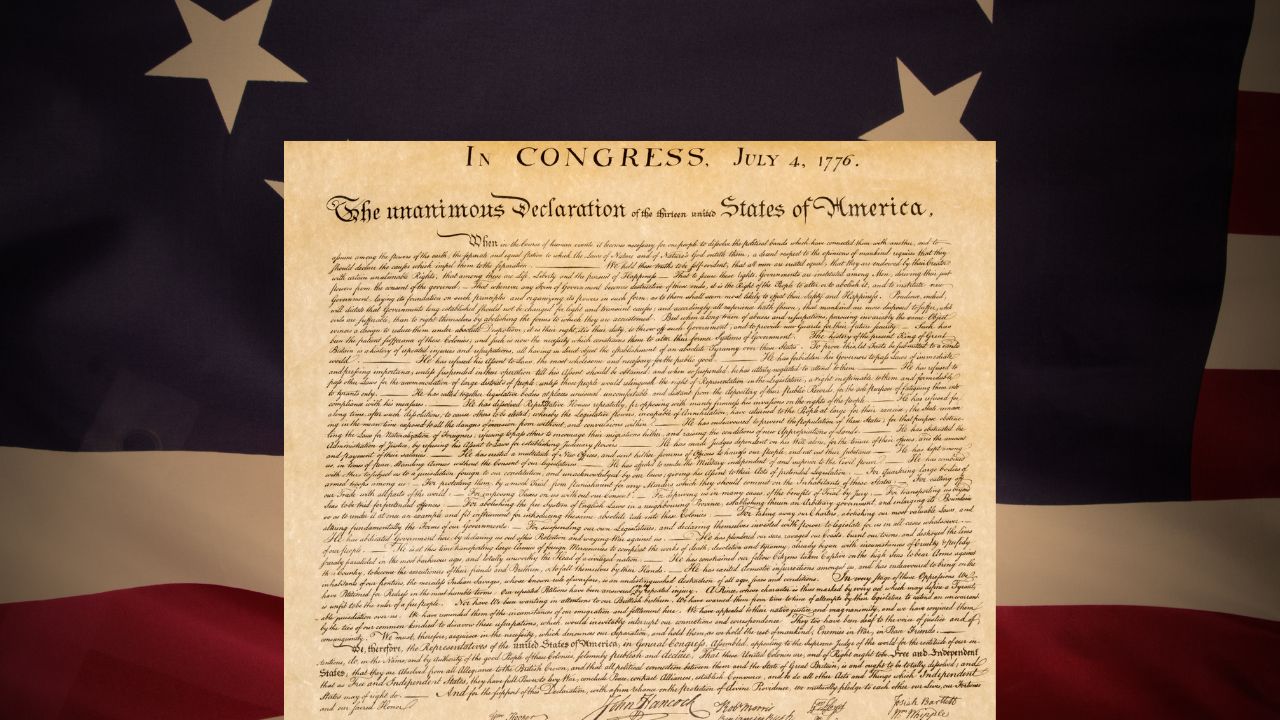
The Founders who wrote the document we are celebrating this July did not bracket God as a polite formality. They grounded the entire project in Him. The Declaration of Independence does not say government generously grants rights to citizens. It says rights come from the Creator, and government exists only to recognize what is already true. Remove God from that sentence and the whole architecture collapses. Rights become whatever the powerful decide to permit today and revoke tomorrow. The Founders were not embarrassed by this. They assumed it was obvious.
Sorkin’s anchor ends his tirade by mourning what America used to be. He says we were great once. We stood up for what was right. We were informed by great men, men who were revered. He says this with apparent sincerity, apparently without noticing that the speech he just delivered is precisely the opposite of the thing he is mourning. He mocks faith, sneers at defense, and calls the youngest generation in the room the worst ever — and then laments that we no longer aspire to intelligence or revere great men.
The irony is not subtle. But the lesson was absorbed anyway.
Sorkin’s anchor presented himself as a man of evidence. Rankings. Data. Percentages. He was not trafficking in sentiment or tradition — he was following the facts wherever they led, unlike the rubes who believed in angels.
Except he was not.
Take the infant mortality statistic he cited with such confidence. America’s ranking looks poor in international comparisons because America counts premature births that other countries record as stillbirths or do not count at all. A baby born at 22 weeks in the United States is recorded as a live birth and, if she dies, as an infant death. In many European countries that same child is classified differently from the start. The comparison Sorkin presented as damning evidence of American failure is largely a measurement artifact. It is not science. It is the appearance of science deployed for a predetermined conclusion.
This is the pattern, not the exception. Sorkin created a perfect character in that moment to show us the way that the media (who has currently the lowest trust in recorded history as an institution) loves to inject opinion and often badly formed opinion, into journalism as fact. Jimmy Kimmel, Jon Stewart, Scott Pelley, the list is a long one.
The same cultural class that wrapped itself in Sorkin’s speech, the people who will tell you that America is ignorant and provincial and that we must follow the science, has compiled a remarkable record of not following science when it becomes inconvenient.


Al Gore put specific predictions in print. Coastal cities by specific dates. Arctic ice gone by specific years. Hurricanes multiplying beyond anything the historical record had seen. He said these things with the authority of settled consensus, collected awards and wealth promoting them, and then sold his environmentalist media holdings to a sovereign wealth fund built on oil revenue. The predictions did not come true. The financial arrangements were not examined with the same intensity the predictions were promoted. The people who told you to trust the science moved on to the next alarm without accounting for the last one.
The same institutions that demand you follow the science also tell you that biological sex is a spectrum, that a man who identifies as a woman is a woman in every sense that matters, and that the answer to that claim is not evidence but affirmation. This is not science. Watching a clearly disturbed tenured “professor” unable to answer the basic question “What is a woman?” in a documentary filmed at the University I graduated from is disturbing evidence.
“Follow the science” folks will tell you that a child in the womb is not a human being with a right to life. Embryology textbooks have not changed. The biological facts of when a distinct human organism with unique DNA comes into existence are not contested in the scientific literature. What is contested is the moral and legal weight of those facts, which is a philosophical question, not a scientific one. But the people who tell you to trust the science do not say they are making a philosophical argument. They say the science is settled.
And the social sciences. An entire apparatus of academic publishing has produced a generation of studies in fields like implicit bias research and certain strands of gender studies that cannot be reproduced. The replication crisis is not a fringe complaint. It is documented across hundreds of published studies in peer-reviewed journals. New categories of knowledge are invented, journals are founded to publish them, credentials are granted to study them, and young people are taught their conclusions as fact. When a research team goes back to test the underlying findings, they frequently discover the original results do not hold.
The generation taught by this apparatus is not more scientifically literate than the one before it. It is angrier. It is sadder. Mental illness among young Americans, and particularly young women, is higher than at any point in recorded history. Anxiety, depression, and diagnosed psychiatric conditions have climbed in direct proportion to the dominance of the institutions that promised to replace superstition with reason. The girls who were told that faith is for the ignorant and America is not worth loving are not flourishing. They are medicated and despairing in record numbers.
This did not happen by accident. It was not simply the natural evolution of ideas in a free society. It was a strategy, articulated clearly by people who understood that America could not be defeated from outside as long as it believed in itself from within.
Antonio Gramsci, writing from an Italian prison in the 1930s, argued that the path to revolution in the West did not run through the factory floor or the barricades. It ran through the institutions. Capture the universities. Capture the schools. Capture the press and the entertainment industry and the legal establishment. When you have shaped what a civilization believes about itself, the political transformation follows as a matter of course. This was not a fringe idea. It was systematically developed by the Frankfurt School theorists who fled to American universities, by Herbert Marcuse who provided the philosophical framework for the 1960s New Left, by Jacques Derrida and the deconstructionists who taught a generation of academics to treat every received truth as a power structure in disguise.
The goal was always the same: sever the branch. Cut the connection between a people and the roots that sustained them, their faith, their families, their inheritance, their story about themselves. A people who do not know who they are will not defend what they have. A people who have been taught that their fathers were villains will not build on what their fathers built.
Sorkin’s generation absorbed this. They did not invent it. They were the product of it. The angry professor, the condescending anchor, the liberal writer bemoaning American ignorance, they believed they were brave. They believed they had discovered something urgent and novel that the masses were too provincial to see. They were, in fact, repeating the oldest lie in the record.
Not a frontal assault on the truth but a raised eyebrow, a suggestion that what you have been given is not what it appears, that the people who handed it to you had interests they were not disclosing, that the sophisticated position is skepticism and the naive position is belief. The serpent in the Garden of Eden did not argue for evil. He argued for a more nuanced reading of what God actually meant.
Sorkin did not argue that America was terrible. He argued that the confident belief in American greatness was the belief of the unexamined, the provincial, the uneducated sorority girl who had accidentally wandered into a voting booth. The sophisticated person had moved past that. The sophisticated person followed the data.


In the 1970s and 1980s, American schools had veterans in them. Men who had stood over the graves of friends in places they could not have found on a map before the draft notice arrived. They taught history from the inside. They did not need to perform patriotism because they had paid for it. When they told students that America was worth defending, the weight behind those words was not theoretical.
Those men have largely left the building. They were replaced, over decades, by a generation of educators trained in institutions that had long since decided that the proper posture toward American power was suspicion. The new curriculum had a different set of assumptions. America was not exceptional. America was a colonial project. The same nation that rebuilt Germany and Japan after defeating them, that spent its treasure and its sons to stop the Soviet advance across Europe, that created the most productive and innovative economy in human history, was recast as just another empire, and a particularly hypocritical one at that.
This is a lie that fails on its own terms. Empires annex. Empires extract. Empires do not rebuild their defeated enemies into prosperous democracies and then bring them into a mutual defense alliance. What America did in the postwar world has no historical parallel. You can find much to criticize in American foreign policy across two centuries. You cannot honestly call it colonialism by anyone who knows what colonialism actually looked like. But honesty was not the point. Deconstruction was the point.
If you want to build a new order, you must first make the people living in the old one ashamed of it. You need the young. Sorkin’s speech was a recruiting tool dressed up as journalism.
Polls now tell the story plainly. Half of Republicans say America stands above all other countries in the world. Seven percent of Democrats say the same. That is not a policy disagreement. That is two different civilizations sharing a zip code.
About 3 in 10 Americans now say there are better countries than the United States, up from 19% in 2016. That 11-point shift in a decade tracks almost perfectly with the institutional capture of education, media, and entertainment by the worldview Sorkin was modeling.
Thirty-seven percent of Americans have lost a relationship over politics. When researchers looked at who was doing the cutting, the answer was not ambiguous. Democrats were more than twice as likely to have initiated the breakup. Among liberals under 45, nearly three-quarters say ending a friendship over politics is acceptable.
A liberal writer recently lamented that the national unity of the 1976 Bicentennial is gone. Vietnam was raw then. Watergate was fresh. The economy was stagnant. And yet Americans gathered and celebrated, agreeing that the country was worth honoring even while disagreeing loudly about its direction.
What changed? She could not quite say.
What changed is that one side of the American conversation decided, somewhere between Sorkin’s generation and his audience’s, that patriotism was provincial, that faith was backward, that the men who fought and built and sacrificed deserved a more critical reading. The other side did not change very much. The gap between 50% and 7% is not a mystery. It is a curriculum.
She wondered if that is just because her party is out of power. The answer is no. Sorkin’s speech happened during Obama’s presidency. Can anyone guess why, even when in power, people celebrate a privileged lawyer who said “For the first time in my adult lifetime, I am really proud of my country” tend to not be proud of America today? When Republicans are not in power, including through the Obama presidency, they stayed proud of America, the data shows that line is only moving downward for one group, and they are following the leaders.
America is not a perfect nation. No nation is. We have accumulated real sins alongside real glory and an honest accounting includes both.
But around the world, people are paying everything they have — leaving behind families, crossing deserts, taking to open water — for the chance to live under the rights and freedoms that too many people born here treat as embarrassments or abstractions. They are not confused about whether this is a good country. They are voting with their feet. By the millions!
The safe liberal democracies of Western Europe that Sorkin’s anchor held up as superior to America exist under a security umbrella that Americans built and Americans fund. The ingratitude goes further than a television monologue. It is structural. The countries that most loudly question American power are the countries most quietly dependent on it.
The Founders said it plainly. God made men. He made them with dignity. He gave them rights that no government created and no government can legitimately take away. Government’s job is to recognize that fact and protect it. That is the reason America was founded. It is the reason the experiment has lasted 250 years. It is the reason enemies rebuilt into allies prospered under our protection. It is the reason the world’s most powerful military has not, in the end, chosen empire.
The solution to the gap between our perception of America is not a better curriculum, though better curricula would help. It is not a different political party in power, though policy matters. The solution is the one the culture most mocks and least wants to hear. Repentance. Return. A turning back toward the things that actually produced the civilization worth celebrating, ordered liberty rooted in the recognition that our rights come from God and that no man, no government, and no academic journal gave them to us or can take them away.
Sorkin mourned that we used to be informed by great men who were revered. He said this while mocking the faith that made those men what they were.
He did not recognize the contradiction.
The men who taught us, the veterans who carried the weight of real sacrifice into classrooms and handed it to the next generation, were great men. They were revered. They knew something Sorkin does not.
America is worth celebrating. The long arc of 250 years, with all its failures and all its glory, bends toward a simple truth that was written down at the beginning and has never been improved upon:
We hold these truths to be self-evident, that all men are created equal, that they are endowed by their Creator with certain unalienable Rights, that among these are Life, Liberty and the pursuit of Happiness.
That sentence did not come from a television writer. It came from men who were willing to die for it.
It is still worth dying for.
It is truth that informs a life worth living and a country worth celebrating. Every day. But especially on this particular 250th birthday.

Clayton Wood is a Knoxville lawyer and pastor. He is a contributing writer for TriStar Daily.