

In 1976, America was objectively worse off than it is today. Unemployment was above six percent. Inflation was eating paychecks alive. Vietnam had ended a year earlier in humiliation, Nixon had resigned in disgrace, and the country was still absorbing assassinations, riots, and a decade of upheaval that had not fully healed.
And yet America threw itself a party.
Tall ships sailed into New York Harbor. Small towns held parades. Families gathered for fireworks with a kind of unselfconscious joy that, fifty years later, feels almost foreign to us.
Patriotism has not simply declined since then. It has divided along party lines.
According to Gallup’s 2025 figures, 92 percent of Republicans say they are extremely or very proud to be American. Only 53 percent of independents and 36 percent of Democrats say the same.
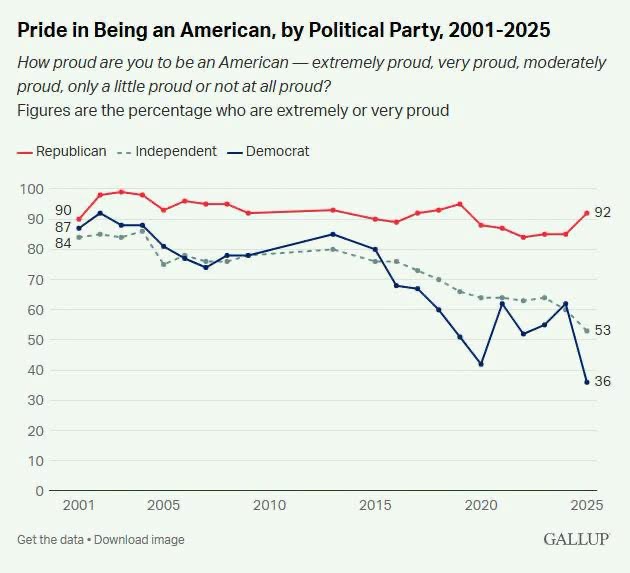
That is not merely a decline in national confidence. It is the partisan division of patriotism itself.
In 2001, the three groups were separated by only a few percentage points. Republicans, Democrats, and independents could disagree bitterly over politics while still sharing a basic affection for the country in which those arguments occurred. Today, one party remains overwhelmingly proud of America while pride among the other has collapsed.
Something has gone wrong that cannot be explained by economics alone, because in 1976 the economics were worse and the pride was higher.
I want to name the thing that changed, because naming it is the first step toward undoing it.
Its name is Howard Zinn.
That is not to say that one historian, acting alone, destroyed American patriotism. The intellectual revolt against America began before Zinn and extended far beyond him. But no popular historian did more to give that revolt a simple, readable, emotionally powerful story that could be taught to generations of American students.
The lie was not that America had sinned.
America has sinned, grievously at times.
The lie was that America was nothing more than its sins, that its ideals were merely camouflage for power, that its heroes were frauds, that its achievements were accidental or stolen, and that love of country was therefore evidence not of gratitude but of ignorance.
That lie did not break my love of country. It did not break the love of millions of Americans who remain profoundly grateful for their inheritance.
It did something nearly as dangerous.
It broke our unity.
It destroyed much of the shared patriotic consensus that once allowed Americans with radically different politics to recognize that they still belonged to one another.
The man who taught a generation to hate its own house
In 1980, four years after the bicentennial, Howard Zinn published “A People’s History of the United States”. It has sold more than 2.6 million copies. It is assigned in high schools and colleges across the country, and the Zinn Education Project has spent decades building curricula, workshops, and teacher training around it, so that its framework now reaches students who have never opened the book itself.
Zinn did not claim to be writing objective history. He said so plainly. His goal was what he called “quiet revolution,” a retelling of the American story from the bottom up, weighted deliberately against what he saw as the false comforts of national pride.
The trouble is not that Zinn told hard truths the old textbooks skipped. Every honest historian agrees that slavery, the treatment of Native peoples, and the abuses of industrial capitalism deserve unflinching treatment.
The trouble is what serious historians, including many on the left, have found underneath Zinn’s method.
Sam Wineburg, a historian of education at Stanford, spent years documenting how Zinn built his case: leading questions, cherry-picked sources, and disputable claims dressed up as settled fact.
In one widely cited example, Zinn claimed that black Americans showed “widespread indifference, even hostility” toward the American war effort in World War II, and he supported the claim with three quotations pulled from a single source. Wineburg went back to that source and found that Zinn had left out the same author’s evidence that black Americans were actually underrepresented among draft evaders and conscientious objectors.
That is not selective emphasis.
That is building a conclusion and then hiding the facts that contradict it.
Zinn’s own sympathetic biographer, the historian Martin Duberman, a man of the left himself, wrote that Zinn’s version of the past “has been justly criticized as leaving out too much, of presenting a partial and thereby distorted account.”
Historians Chris Beneke and Randall Stephens documented blatant omissions and an uncritical reliance on biased sources. Mary Grabar’s full-length rebuttal, Debunking Howard Zinn, traces case after case where Zinn misused evidence or hijacked other historians’ research to fit a predetermined narrative of America as, in her words, a tyrannical and imperialistic regime rather than the freest nation in world history.
Even a reviewer sympathetic to Zinn’s project admitted that he judged every American decision, including entry into both World Wars, in the worst possible light, while barely mentioning atrocities committed by regimes he found more ideologically congenial.
He described Stalin’s Soviet Union after 1953 as having opened up to “remarkably open discussion.” He described Mao’s revolution, which killed tens of millions, as a movement with “enormous mass support.”
This is not a minor academic dispute.
This is the book that, more than any other single text, taught two generations of American students that their country’s founding was not a flawed but remarkable act of ordered liberty, but rather a story of theft and oppression from top to bottom, worthy only of suspicion.
You cannot run that curriculum through a nation’s schools for forty years and then be surprised when pride collapses.
Zinn did not report a decline in American greatness. He manufactured a historical narrative designed to produce suspicion, alienation, and shame, and the narrative worked exactly as he intended it to.
The long march toward forgetting
Zinn did not invent this intellectual revolt against the American inheritance. He popularized one especially effective version of it.
Before Zinn came Antonio Gramsci.
Gramsci understood that a revolutionary movement could not permanently transform the West merely by storming government buildings or seizing economic assets. Political power rested upon something deeper: cultural authority.
A people’s understanding of what is normal, admirable, shameful, sacred, and true is formed through institutions. Families form it. Churches form it. Schools form it. Universities form it. Newspapers, entertainment, professional associations, and civic organizations form it.
A revolution that captures the government but leaves those institutions intact may eventually fail. A revolution that captures the institutions can transform a civilization without ever appearing to overthrow it.
The Frankfurt School extended Marxist criticism beyond factories and economic classes into culture, religion, sexual morality, family life, inherited authority, and the structure of Western society itself.
The old Marxism had said that history was primarily a conflict between economic classes. The newer critical theories expanded the number of oppressors and oppressed until nearly every inherited relationship could be viewed through the same suspicion.
Parent and child. Husband and wife. Clergy and congregation. Teacher and student. Citizen and nation. Male and female. Majority and minority. Settler and Indigenous person. Western society and the rest of the world.
Every relationship could be reconstructed as domination.
Every inheritance could be treated as a mechanism of control.
Every loyalty could become evidence of false consciousness.
Saul Alinsky contributed a different part of the project. He was less interested in writing a grand theory of history than in teaching activists how to organize grievances, concentrate pressure, isolate targets, manufacture confrontation, and acquire power.
Alinsky understood that politics is not merely the exchange of ideas. It is the organization of people, pressure, conflict, fear, embarrassment, and institutional leverage.
Later radicals spoke openly of a “long march through the institutions,” a patient effort to occupy the places where a civilization forms its memory and moral imagination.


These men were not all saying precisely the same thing. They did not sit around one table and design the American university of 2026. Gramsci, the Frankfurt School, Alinsky, and Zinn represent different streams of theory, culture, history, and organizing.
But those streams eventually converged.
Gramsci explained why cultural institutions mattered.
The Frankfurt School supplied a method of suspicion directed toward inherited Western life.
Alinsky supplied practical methods of organization and pressure.
Zinn supplied the American historical narrative.
Zinn gave the long march its textbook.
And the bitter fruit is now visible.
At some of the wealthiest universities in the world, coddled children of extraordinary privilege put on the costume of revolutionary allyship and demonstrate on behalf of Hamas, an Islamist terrorist movement that would crush nearly every fashionable identity these students claim to defend.
Students at Columbia and other elite universities have occupied buildings, harassed Jewish students, celebrated “resistance,” and adopted the symbols and slogans of a movement responsible for the deliberate murder, kidnapping, rape, and torture of civilians.
Some have done so while presenting themselves as champions of women, sexual minorities, religious pluralism, and human rights.
“Queers for Palestine” is not merely an amusing contradiction.
LGBTQ activism on behalf of Islamist terror is the bitter fruit of a carefully cultivated and deeply warped tree of confusion and delusion.
It is the logical endpoint of an education that has trained students to divide the world into oppressors and oppressed, then suspend every other moral judgment once those labels have been assigned.
Once Israel and the West have been placed in the category of oppressor, nearly any force opposing them can be romanticized as liberation.
The actual beliefs and conduct of that force become secondary.

It no longer matters that Hamas governs through religious authoritarianism, subjugates women, persecutes dissent, glorifies martyrdom, targets civilians, and would never tolerate the sexual revolution celebrated on American campuses.
It no longer matters that an openly gay student loudly endorsing Hamas from the safety of Columbia University would enjoy no comparable safety under Hamas rule.
Ideology has destroyed the student’s ability to perceive reality.
America, despite its freedoms and its unmatched capacity for self-correction, must always be the villain.
Any force opposing America or the West must therefore contain some liberating virtue, even when that force murders children and builds its political theology around hatred.
This is not compassion enlarged by education.
It is moral perception destroyed by ideology.
Oikophobia: the sneer with a diploma
The British philosopher Roger Scruton gave this pathology a name in 1993, refined a decade later in his book “England and the Need for Nations”.
He called it oikophobia, built from the Greek oikos, meaning home, and phobos, meaning fear or aversion.
Where xenophobia is an irrational fear of the foreigner, oikophobia is its mirror image: a compulsive need among a nation’s own educated elite to denigrate the customs, institutions, and loyalties that are identifiably theirs, while idealizing whatever is foreign or abstract instead.
Scruton called it an adolescent posture, a rebellion against home that most people outgrow.
His diagnosis was that in the modern West, the credentialed class never outgrew it.
It became their permanent personality.
You and I have both watched this up close.
It shows up as a reflexive curling of the lip at the flag, at the pledge, at the nuclear family, at the local church, at anyone who says the word patriotism without irony.
It dresses itself up as sophistication.
It calls itself being a global citizen, unbound by something so parochial as a border.
But strip away the vocabulary and what is left is condescension: a conviction that the people who love God, love their families, and love their country are provincial, unenlightened, perhaps even dangerous, while the people who have learned to doubt all three have achieved a higher moral plane.
Scruton traced its roots back through the Enlightenment’s flirtation with global citizenship over national citizenship, and you can watch the same instinct today in the way that inherited identity gets treated as suspect while chosen, deracinated identity gets treated as virtuous.
This is a moral inversion, and it has been embraced with real enthusiasm by exactly the class of people who run our universities, our newsrooms, and our cultural institutions.
It is why a Wall Street Journal poll found that the share of Americans calling patriotism extremely important fell from 70 percent in 1998 to 38 percent twenty-five years later, while the share calling money extremely important was the only value in the survey to rise.
It is why Gallup now finds a fifty-six-point gulf between Republicans and Democrats when Americans are asked whether they are proud of their country.


Zinn supplied the historical content.
Oikophobia supplied the posture.
Gramsci supplied the theory of cultural power.
The Frankfurt School supplied a vocabulary of suspicion.
Alinsky supplied methods of institutional struggle.
Together, their descendants taught a generation to feel superior for despising what their grandparents loved without irony in 1976.
But the right has its own reasons to distrust the state, and they are not imaginary
Here is where I want to be thorough rather than merely partisan, because a one-sided essay would be a lesser thing than the truth deserves.
It is not only the credentialed left that has stopped trusting American institutions.
Those of us who have always believed in the possibility of a just and neutral state, that obeys the constraints of the Constitution. People on the right who do not reflexively distrust government the way libertarians do, have watched that trust erode for reasons that have nothing to do with Howard Zinn and everything to do with the government’s own conduct.
Edward Snowden showed the country that intelligence agencies were sweeping up the communications of ordinary Americans, in violation of the constitutional protections those agencies swore an oath to defend, and did so for years while denying it under oath.
Lois Lerner targeted political opponents through the IRS and walked away.
James Clapper told Congress under oath that the NSA did not collect data on millions of Americans, a statement later shown to be false, and faced no consequence.
John Brennan and James Comey made public statements about the Russia investigation that later oversight found to be misleading at best, and both kept their reputations largely intact within elite circles.
Fifty-one former intelligence officials signed a letter dismissing the Hunter Biden laptop story as bearing the hallmarks of Russian disinformation in the final weeks of a presidential election, and it later proved to be exactly what it appeared to be.
That happened four years after the same institutional class had spent an election cycle promoting a Russian collusion theory that collapsed under its own weight.
And through COVID, Americans were told with absolute confidence to trust experts who reversed themselves repeatedly on masks, on distancing, on school closures, and on the origins of the virus itself, without ever quite admitting how much of what they projected as settled science had in fact been improvised.
None of that is Howard Zinn’s fault.
It is the government’s own fault, and it has done real damage to the case for trusting institutions that should uphold justice instead of perverting it.
But part of our present confusion comes from failing to distinguish between four different things:
Love of country.
Trust in government.
Approval of current leaders.
Confidence in particular institutions.
These are not the same thing.
A man can love America and distrust the FBI.
A woman can honor the Constitution and oppose the president.
A citizen can celebrate the Declaration of Independence while condemning slavery.
A patriot can demand accountability from the intelligence agencies, universities, courts, corporations, and public health bureaucracies because he loves his country, not because he despises it.
Indeed, love demands correction.
A man who loves his house repairs the roof.
A woman who loves her church confronts corruption within it.
Parents who love their children discipline them.
Citizens who love their nation do not remain silent when its institutions lie, manipulate, persecute, or abuse their authority.
Patriotism is not submission to the state.
It is loyalty to a people, a place, a constitutional inheritance, and a common life that exists before and beyond any temporary government.
What remains to hold us together
So look at where that leaves the country as it turns two hundred and fifty.
The credentialed left has been taught, by Zinn’s history and reinforced by oikophobia’s sneer, to see love of country as embarrassing at best and dangerous at worst.
Those of us who wanted to believe in strong institutions have watched those institutions lie to us again and again, on matters as serious as constitutional rights, election integrity, and public health, without a single meaningful consequence for the liars.
The right does not trust the institutions.
The left does not love the country.
What, then, is left to hold two hundred and fifty years of a shared inheritance together?
In 1976, with double-digit inflation and a war just lost, the answer was simple.
It was love of nation, held in common, prior to and deeper than any argument about who was in the White House.
That love did not require the government to be trustworthy.
It did not require historians to flatter the founders.
It did not require citizens to deny slavery, segregation, corruption, war, or injustice.
It required only that Americans believe, together, that this was still their home and still worth defending.
That belief is not gone.
But it is no longer equally shared.
Republicans have not abandoned patriotism. They remain overwhelmingly proud to be American. The collapse has occurred primarily among Democrats and, to a lesser degree, independents.
The lie did not break every American’s love.
It broke our agreement that love of country should exist before politics.
It created a divorce between the parties in which patriotism itself became contested property.
One side increasingly treated love of country as a virtue.
The other increasingly treated it as evidence of moral blindness.
America did not merely lose confidence.
It lost one of the few loyalties that once existed prior to politics.
That shared loyalty has been targeted for two generations by people who mistook contempt for wisdom, and it has been starved by institutions that mistook their credentials for freedom from accountability.
Media and Washington are much more distrusted today than at the height of Watergate, and the distrust is well earned.
The answer is not to pretend the sins in our history did not happen.
It is to teach that history honestly, with all its failures and all its genuine, hard-won triumphs, rather than through a lens built to produce shame as its only possible conclusion.
It is to teach that the same nation that tolerated slavery also produced an abolitionist movement rooted deeply in Christian conviction.
It is to teach that the Constitution compromised with slavery, but also created a durable framework through which slavery could eventually be abolished and equal citizenship claimed.
It is to teach that America displaced Native peoples, practiced segregation, abused workers, and sometimes used its power unjustly.
It is also to teach that America defeated fascism, resisted Soviet communism, rebuilt former enemies, expanded freedom, produced extraordinary prosperity, welcomed generations of immigrants, and repeatedly called itself back toward the universal promises contained in its own founding documents.
Honest history does not require worship.
It does require proportion.
It requires gratitude alongside repentance.
It requires the maturity to understand that a nation may be guilty of terrible wrongs and still be a great gift.
The answer is also to demand real consequences from institutions that lie to the people they serve, on both the right’s grievances and the left’s.
And it is to reclaim, without apology, the plain and unfashionable love that filled the streets in 1976: love of God, love of family, love of home, and love of a nation still worth the name.
A word about the anger, and where it should lead
I will confess something.
There is a temptation, when I watch the same spirit that once showed contempt for returning soldiers now sneering at the country that gave it every privilege it enjoys, to reach for anger as the only honest response.
Today I spoke with a retired colonel who served in Vietnam.
He told me that when he returned home, people spat on him.
He does not need a historian, fifty years later, to tell him that it did not happen.
He was there.
He lived it.
His memory is not a myth merely because some academics have concluded that experiences like his were not universal.
Not every returning veteran was spat upon. Not every American opposed the troops. Many communities welcomed their sons home with love and gratitude.
But some veterans were spat upon. Others were cursed, called murderers, treated as objects of shame, or advised to hide their uniforms.
A nation sent young men to war, then allowed some of them to return home carrying both the trauma of combat and the contempt of the people they had served.
That happened.
And the contempt did not disappear.
It migrated.
Today it is expressed not only toward soldiers, but toward the flag, the anthem, the founding, the church, the family, the border, and the idea that Americans might owe one another a loyalty deeper than politics.
Merle Haggard wrote a song for exactly that feeling, back when the flag burners of his own era were doing to the flag what today’s oikophobes do to the founding.
There is a version of me that wants to sing it right along with him, blood boiling, because the ingratitude on display really is that galling.
They’re walkin’ on the fightin’ side of me
Runnin’ down a way of life
Our fightin’ men have fought and died to keep
If you don’t love it, leave it
Let this song that I’m singin’ be a warnin’
When you’re runnin’ down our country, hoss
You’re walkin’ on the fightin’ side of me
We are, by any honest measure, richly blessed to have been born into the freest and most remarkable experiment in self-government the world has ever produced. To answer that blessing with contempt is not sophistication. It is spiritual sickness.
But Scripture will not let me stop at anger, and I do not think it will let you stop there either.
The anger is not wrong, exactly. It is simply not the last word.
The last word the Bible gives us for people who have traded properly ordered love for something colder is not condemnation. Properly ordered love begins with love of God, then extends to family, the family of God, community, and nation. In its place, many have embraced an abstract global citizenship among people who would abandon them the moment they stopped marching in lockstep with the descent into madness at the core of their movement.
Yet the Christian answer is still compassion.
Think of the father in Luke 15, watching the road every evening for a son who took his inheritance and went looking for something better than home. He did not stand at the gate rehearsing an argument for when the boy came crawling back. He ran to him while he was still a long way off.
That is the posture I am asking us both to hold, even now, even in a season when the ingratitude is loud and the mockery is constant.
The American prodigals who despise their own heritage, who will not gaze in wonder at fireworks, or grill a hot dog, or raise a flag as the Republic turns two hundred and fifty, are not our enemies to be crushed. They are family who wandered into a far country and are eating from a trough that will never satisfy them.
Our answer cannot end with the fighting side.
It must also be the porch light left on.
Pray for them.
Pray that the emptiness of that pigpen eventually does what no argument of ours ever could and turns their eyes back toward home.
Pray that they come to see what you and I already know: that this nation, for all its failures and all its unfinished work, remains a singular gift of common grace, worth loving without apology and worth celebrating without shame as we mark two hundred and fifty years.
God bless America.
And God bless you as you carry that love, patiently and without bitterness, to a hurting world.

Clayton Wood is a Knoxville lawyer, pastor and contributing writer for TriStar Daily.
















GSR
July 4, 2026 at 1:32 pm
Vietnam War ended in “humiliation” because we left. By 1971-72, the war was going much better than earlier years, with US forces nearly all gone and South Vietnam’s much stronger. There really weren’t many big battles in that period. However the war was lost when Congress (Democrat led) refused to continue to supply SV, while the Soviets and Chinese quite lavishly supplied NV.
Andrew B
July 4, 2026 at 2:30 pm
I always wondered how Howard Zinn would have felt if someone decided to write a biography of his mother, but only spoke to people who hated her. The girl she beat out for first chair in the school orchestra, someone who owed her money, someone she owed money to. Interview everyone who ever bore her a grudge, put the most humiliating spin on it, and call it “A People’s History of Mrs. Zinn.” How could he complain?