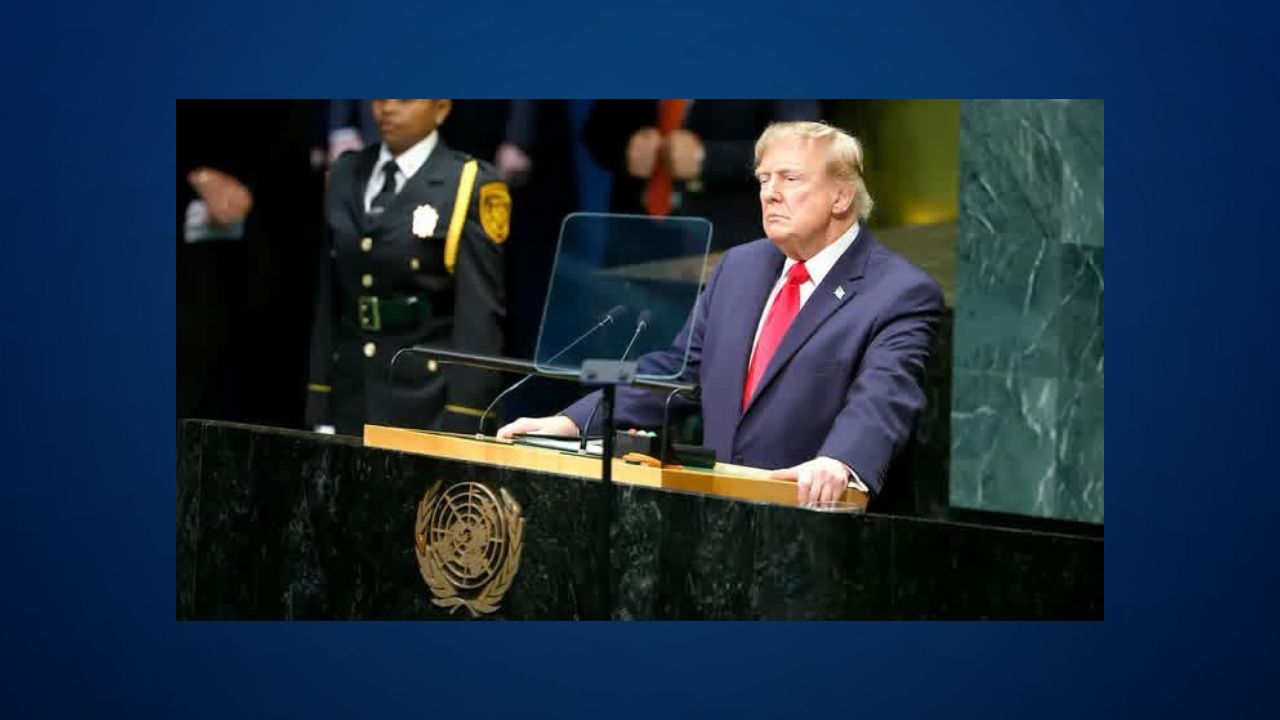

Donald Trump stood in the hall of the UN General Assembly Tuesday and made a claim most of the delegates in that room did not want to hear: that while other leaders talk about peace, he has actually made it. Eight conflicts, by his count, brought to an end since he returned to office: Cambodia and Thailand, Kosovo and Serbia, the DRC and Rwanda, Pakistan and India, Armenia and Azerbaijan, and the war in Gaza. This was a speech full of bluster. It was also quite a record. Look at the record he is pointing to and ask yourself honestly whether the institution built specifically to prevent war can say the same.
Trump has broken so many brains. I went from speaking out strongly against him in 2015 and 2016 (those posts are still up) to being pleasantly surprised by the actual record of a man I still pray will change to be more like Jesus, but whose governance has done more for causes I am passionate about than others whose faith and manner I prefer.
It is hard at times to tell whether we are hearing mistakes or strategy. When he repeatedly says “mutilization,” or claims poverty and crime have never been lower, the media rushes to correct him. Whether he means it or not, the effect is the same: millions of people end up hearing the case for mutilating children’s genitals in its defenders’ own words, and digging into numbers that are incredibly positive and have gone largely unreported.
Trump carries a big subtext whenever he speaks to the UN. It is not really a speech to the delegates. It is a speech about the delegates, delivered to their faces, pointing out that the organization built to keep peace mostly writes strongly worded letters and waits for someone else to do the work. This year the target was Iran.
The Bully No More
Trump described Iran as the country that had spent decades as the chief destabilizer of the Middle East and said flatly that it is the bully no more. Then he laid out the choice in stark terms: a deal that lets Iran rebuild into something greater than it has ever been, or what he called annihilating the Islamic Republic and driving it into hell with no chance of survival and no hope for its future generations.
That is not diplomatic language. It is not supposed to be. Trump has made a habit of using maximum pressure rhetoric as a substitute for maximum pressure military action, and it has worked often enough that it is hard to dismiss as empty talk. He also asked the rest of the world to keep Iran completely isolated economically until it stops attacking commercial shipping and funding terrorism. He predicted the real deal will come after the midterms, which tells you how he reads the IRGC. He believes the regime is waiting him out politically rather than militarily, hoping a different Congress changes his leverage. He also made it clear that no matter what happens in the midterms, Iran will not have nuclear weapons.
Venezuela and the Price of Being Wrong About America
Trump issued a very clear warning to the world. He noted that Venezuela had some of the finest military equipment other countries could supply, and none of it stopped the United States from coming and taking their target. That line was not really about Venezuela. It was about China, the supplier of much of that equipment, and the message could not have been clearer: your systems did not even slow us down. Maduro was working with China, Iran and Cuba. Now he is sitting in a prison cell.
Pair that with the oil deal, which Trump put at 65 billion barrels. His claim that American and Venezuelan production together make up 60 percent of the world’s oil supply is an exaggeration, and the real share is far smaller. But the shape of the strategy goes well beyond one country. “To the victor go the spoils,” as Trump put it. It is blunt. It is also honest about how great power competition actually works, which is a rare thing to hear from a politician, especially one speaking at the UN.


Trump also described his zone of control more clearly and declared the end of unchallenged cartel power. Calling the cartels the ISIS of the Western Hemisphere and treating them as a terrorist enterprise rather than a law enforcement nuisance is a real shift in posture. It explains why the administration has been willing to use military tools against targets that past administrations treated as a DEA problem.
Cuba, Greenland, and the Places Everyone Else Gave Up On
The Cuban delegation walking out when Trump said their government will fall tells you they believed him enough to be angry about it. He credited Rubio with the negotiating work there. Cuba has been an intractable problem for every American president since Eisenhower. If this administration actually cracks it, on top of Venezuela and Gaza, the foreign policy legacy here becomes arguably the most consequential since the end of World War II.

Then there is Greenland. When Trump first raised it, the idea was treated as a joke. Today he told the world that an agreement with Denmark and Greenland is about to be signed, one he said would give the United States permanent control over security there and strengthen NATO across the Arctic and North Atlantic. As the Arctic opens, Russia and China both want a foothold there. America just secured it.
The Numbers Behind the Claims
Trump also spent time on immigration, drug smuggling and crime. It sounds like the brag politicians always make, but check the numbers.
The FBI’s 2025 numbers show murder and non-negligent manslaughter down 18.1 percent year over year, with the national murder rate falling to 4.1 per 100,000, tied with the mid-1950s for the lowest rate in the FBI’s entire statistical series. Violent crime overall fell 9.3 percent, the largest single-year decline in the FBI’s national estimates. Robbery fell 18.5 percent. Property crime fell 12.4 percent. Overdose deaths tell a similar story. The CDC estimates just under 70,000 overdose deaths in 2025, down almost 14 percent from 2024, the third straight annual decline, with the drop continuing into 2026. Southwest border encounters collapsed from roughly 118,000 in May 2024 to under 9,000 in May 2025, a reduction of 93 percent, and monthly apprehensions have stayed in that low range all year.
None of that is spin. Those are the government’s own numbers.


Causation is more complicated, and this is where people who hate Trump will say, “The good news is true, but do not give him credit, it was getting better before he got there.” The murder and overall crime decline did begin in 2024, before Trump took office, as the post-pandemic crime surge started reversing on its own. The overdose decline started before 2025 too. So he inherited momentum on those two fronts rather than starting them from scratch. What he can claim much more directly is border control, which we were told was logistically and practically impossible, and which he actually achieved.
Trump also pointed to the National Guard deployments in Memphis and Washington. Critics say he chose cities run by his political opponents. The better question is why the leaders of those cities were not fixing the violence themselves. DC’s numbers really have improved. Homicides fell 41 percent in the first half of 2026 compared to the first half of 2025, carjackings fell 63 percent, and motor vehicle theft fell 54 percent. But the same reporting period shows aggravated assaults up 45 percent and gun assaults up 13 percent, which is not the picture of a uniform turnaround. Memphis police were already reporting a 25-year low in overall crime and a six-year low in murder before the National Guard deployment was even announced, which means some of what gets credited to the troops was already happening. Still, Trump sent troops and crime went down. Had crime gone up anywhere he sent troops, it would have been the only story anyone covered. It did not happen.
The country really has gotten safer, the overdose crisis really has eased, and the border really has been transformed almost overnight. Crediting all of it to eight months of federal troop deployments in a few cities overstates what the researchers can actually show. Crediting none of it to the administration ignores a border policy shift with a timeline too tight to be coincidence. Numbers this good do not need to be inflated to make the point.
Armenia, and a Word That Deserves to Be Used Carefully
Trump also touted the peace deal he brokered between Armenia and Azerbaijan, and he deserves the credit. Azerbaijan won the war on the battlefield in September 2023, after a nine-month blockade of the Lachin corridor and a one-day offensive, and more than 100,000 Armenians fled Nagorno-Karabakh along that same road. They left homes, churches and graves their families had kept for generations. What nobody could do was turn that outcome into peace. Moscow couldn’t, Brussels couldn’t, and the Minsk Group spent thirty years failing to. In August 2025, Trump did. Both Pashinyan and Aliyev said so at the White House and said they would nominate him for the Nobel Peace Prize.
Now imagine Israel drove Gaza’s population out by force, then signed a peace treaty that never mentioned their return, and the UN welcomed it. The outrage would be universal and permanent. That is almost exactly what happened to the Armenians of Karabakh. The treaty does not mention Karabakh. There is no right of return. The world moved on, and fourteen months after the exodus, the UN held its annual climate summit in Baku. When Trump merely floated relocating Gazans in February 2025, the UN Secretary-General warned against ethnic cleansing within a day.
The usual answer is that Armenia signed the deal and Armenia took its people in. That is true. It is also the point. Displacement becomes permanent when a homeland absorbs its refugees and the world stops funding the grievance. For Palestinians, the world keeps funding it through UNRWA, which extends refugee status to a fourth generation of descendants. The UN’s own investigators found that UNRWA employees may have taken part in the October 7 massacre, and Hamas built a tunnel and data center underneath UNRWA’s Gaza headquarters.
Population separation is not new, and the international system has blessed it before. The 1923 Treaty of Lausanne exchanged well over a million Greeks and Turks. In 1975, under UN auspices, Turkish Cypriots in the south of Cyprus were allowed to move north, and northern Cyprus has since been reshaped further by settlers brought in from Turkey, distinct from the Turkish Cypriots whose community has lived on the island for centuries.
The principled line is between people who agree to move and people forced out at gunpoint. That line condemns what Azerbaijan did in 2023. It also demands the same standard in Gaza, in Cyprus and everywhere else. Instead, the vocabulary and the outrage depend on who is doing the moving and who is being moved.
Genocide is the deliberate destruction of a people, in whole or in part. Armenia gave the world the reason that word exists, since the slaughter of Armenians by the Ottoman Turks was one of the crimes it was coined to describe. That is exactly why it should not become a synonym for every tragedy, or be withheld when the victims are unfashionable. We should decide what we believe before we decide whom we like.
NATO, the ICC, and the UN Itself
The NATO number Trump cited, moving allied defense spending commitments from 2 percent up toward 5 percent, reflects the pledge made at last year’s Hague summit rather than money already spent. It is a real shift in burden sharing even so, and this administration has pushed it harder than any of its predecessors. Pair that with his reference to new tariff authority and the willingness to use it, and you get a president who treats economic leverage as inseparable from security policy. Allies do not love that approach. It has also produced more actual concessions from those same allies than a decade of polite requests did.
He clearly wants an end to the war between Russia and Ukraine. I plan to write separately about Russia rattling aggression toward Estonia and Japan while losing ground in the Donbas. Trump has pressure available, and NATO actually carrying its own weight helps with that.
Trump called the International Criminal Court “full of evil people,” said it has no jurisdiction over the United States, and urged nations to leave it. That will generate outrage, but the court has made the case against itself. The United States never ratified the Rome Statute, yet the ICC claims the power to prosecute American servicemen and intelligence officers over Afghanistan and refuses to close those cases. Its chief prosecutor sought arrest warrants for Israel’s elected prime minister in the same filing as the Hamas leaders who planned October 7, and he did so a few weeks after two court employees reported him to the court’s watchdog for alleged sexual misconduct. In July, the court’s own member states voted to remove him for serious misconduct, the first time in the ICC’s history that a sitting chief prosecutor has been removed. Five countries announced their withdrawal from the court in the space of two months. Putin has had an ICC warrant since 2023 and travels to member states without being arrested. An institution meant to prosecute the worst crimes against humanity has spent its credibility on cases that look more like political theater than justice.
alhaq
He took aim at the UN Human Rights Council for fixating on the United States while ignoring abuses elsewhere, and at UNESCO and the International Maritime Organization for pushing global governance. Some of his base probably wanted him to announce that America is defunding the UN entirely. He has already done most of it, one agency at a time. In January he ordered the United States out of 66 international organizations and cut off funding for 31 UN-affiliated entities. That came on top of pulling support from the WHO, UNRWA, the Human Rights Council and UNESCO. He is also paying down $850 million of what America owes, for the parts of the UN that still serve American interests. That is leverage. Walking away entirely would hand the institution to Beijing. America pays about 22 percent of the UN’s funding and China pays about 20 percent. Trump would rather hold the purse over the UN than hand it to China.
ms
Superintelligence
The line that may matter most in ten years was a short part of the speech. Trump argued that artificial intelligence should be called superintelligence instead, because “artificial” makes it sound fake, and he declared that whoever wins superintelligence wins. He is not wrong about the scale of what is coming. Whether American policy is actually built for that race is a question I will take up in another essay. He also named exactly one adversary in that race: China. The summit with Xi looms in DC this week.
The Bottom Line
This was not a speech from a man playing defense. Every other administration in recent memory has gone to that podium explaining why intractable problems stay intractable. This one went to explain why they are not intractable anymore. Iran, Venezuela, Cuba, Gaza, Armenia, Greenland, and a border and crime picture that is, by the government’s own numbers, the best it has been in decades. It is a genuinely unusual list for an American president to be able to recite. Trump spoke directly to Iran, to Russia, to China, to cartels and terrorists, and he made it clear that America is aware of the power we possess and will use it to protect our people without embarrassment or apology.

Clayton Wood is the Executive Director of Wears Valley Ranch and Thrive, and a Knoxville attorney and pastor.