
Tennessee’s public schools are changing because the state itself is changing. Families are relocating. Birth rates are declining. Housing costs are rising. Parents have more educational options. Some communities are growing rapidly, while others are losing students. The consequences are significant, and our education policies must recognize these differences.
Consider Middle Tennessee. Over the past decade, school districts in Rutherford, Montgomery, Williamson, and Wilson counties have gained about 27,000 students. Meanwhile, Memphis-Shelby County Schools and many rural districts have seen enrollment decline. One state. Two very different challenges.
Growth brings opportunity, but it also brings costs. More students require additional classrooms, teachers, buses, and support services. Rutherford County Schools, for example, has added thousands of students over the past two decades. School construction and infrastructure planning cannot wait until overcrowding becomes a crisis.
Yet population growth does not automatically translate into public school enrollment. Some newcomers are retirees. Rising housing costs may push younger families farther from employment centers. Other families choose charter or private schools or opt for homeschooling. These factors warrant examination, but no single explanation fits every community.
Declining birth rates pose another challenge. Fewer children born today generally mean fewer students entering kindergarten five years later. That is a demographic reality, not necessarily a reflection of school quality. Nevertheless, districts must prepare for its consequences.
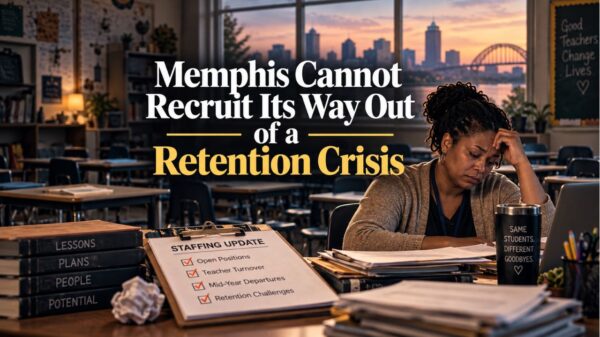
Memphis-Shelby County Schools illustrates the challenge. The district began the 2026–27 school year with more than 2,000 fewer registered students than the previous year, continuing a substantial enrollment decline over the past decade. With fewer students, the district faces difficult decisions about staffing, facilities, transportation, and academic programs.


But declining enrollment should never excuse lowering expectations. The children who remain deserve the same commitment to educational excellence as those in schools in growing communities.

Attendance poses a related challenge. Chronic absenteeism, typically defined as missing at least 10 percent of the school year, continues to disrupt learning across Tennessee. Nearly one in five Tennessee students was chronically absent during the 2024–25 school year. However, attendance and enrollment are not interchangeable terms.
A chronically absent student remains enrolled. Addressing attendance requires understanding barriers such as transportation, family instability, health concerns, and disengagement, rather than treating absenteeism as an enrollment issue. The financial implications are equally serious.
Tennessee’s Investment in Student Achievement (TISA) funding formula accounts for student enrollment and individual educational needs. However, school expenses do not decline proportionally when enrollment falls. A district losing 100 students cannot necessarily eliminate a bus route, close a building, or reduce staffing without affecting educational opportunities.


Rural districts face particularly difficult circumstances. Transportation distances remain long, buildings still require maintenance, and special education services must continue. Qualified teachers must be recruited and retained, even when enrollment is small.
Smith County serves as a warning to other districts statewide. In 2026, the district faced a projected budget shortfall of about $7 million. Rising operating expenses, limited local revenue, and shifting funding conditions created significant financial pressure. Enrollment alone did not explain the problem.
The lesson extends beyond Smith County. When declining enrollment, rising costs, and limited resources converge, smaller school systems have little flexibility. Look at the neighboring Cannon County, which also consolidated schools earlier.

Tennessee must also recognize the approaching end of transitional funding protections tied to the shift from the former Basic Education Program to TISA. The final year of those transition payments is 2026–27. Although separate funding safeguards remain, districts need predictable resources and sufficient time to adjust. We cannot expect local school systems to absorb significant financial changes without adequate planning.
None of this means preserving every building or program indefinitely. Responsible leadership sometimes requires difficult decisions. Consolidation, staffing adjustments, and facility changes may be necessary. Those decisions should be transparent, grounded in reliable evidence, and centered on students rather than driven solely by financial spreadsheets.
The state should take three practical steps: improve long-term enrollment forecasting, assess whether funding adequately covers the fixed costs of rural education, and help growing districts plan for facilities and infrastructure.
Local leaders must also be transparent with their communities. Enrollment trends, attendance patterns, housing changes, and financial projections should inform decisions before problems escalate into emergencies.
Education policy should not pit growing suburban districts against shrinking urban or rural ones. Their circumstances differ, but their responsibility is the same: to provide children with a quality education. A student in Rutherford County matters no more or less than a student in Memphis or Smith County.
Tennessee cannot control every demographic or economic change, but we can anticipate those changes, plan responsibly, and protect educational opportunities. Our communities and schools are changing. State policy must keep pace.
JC Bowman is the executive director of Professional Educators of Tennessee. He is a contributing editor to TriStar Daily