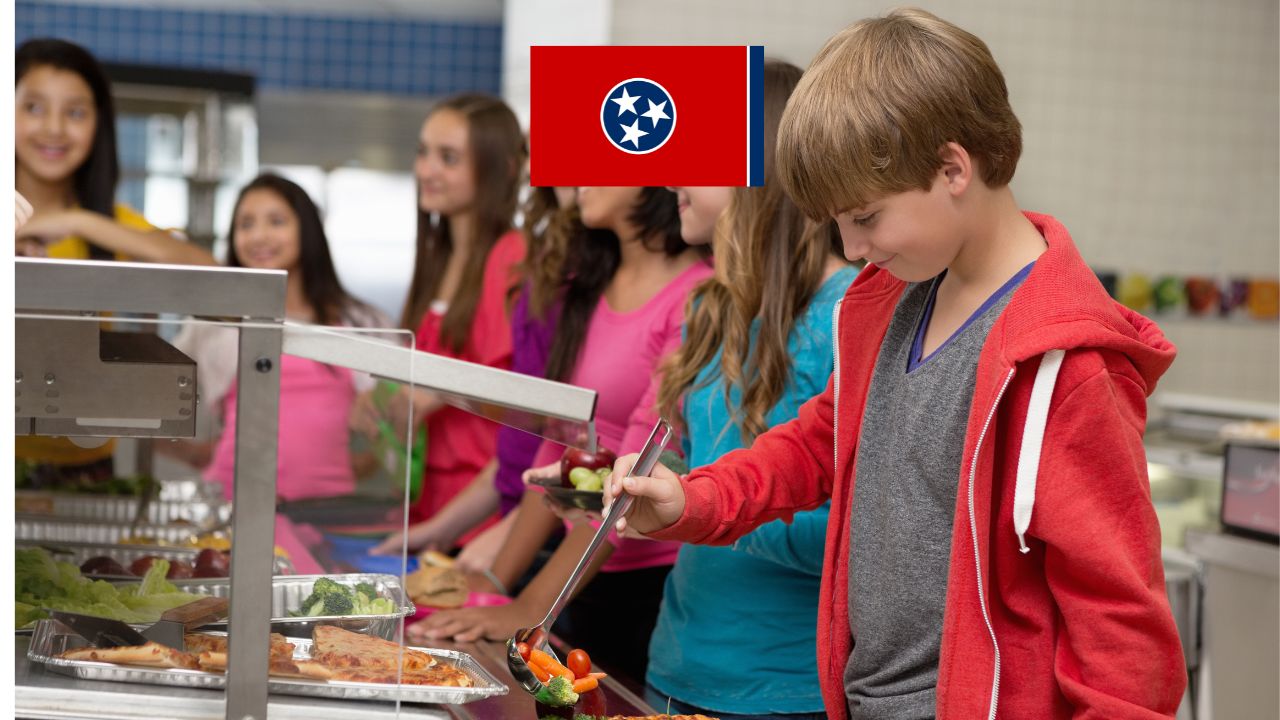

If you want to understand Tennessee school lunch, imagine a giant federal nutrition octopus extending one tentacle from Washington, another through Nashville, and several more into your local cafeteria, where a heroic lunch lady is trying to hand a tray to a sixth-grader who insists that ketchup counts as a vegetable.

This is the National School Lunch Program, which sounds less like lunch and more like a classified military operation. In many ways, it is. The U.S. Department of Agriculture sets the nutrition rules, the Tennessee Department of Education oversees the program statewide, and local school districts handle the actual food, menus, pricing, payment systems, and occasional mystery surrounding whether today’s entrée is technically chicken.
The miracle is not that school lunch exists. The miracle is that millions of meals are served every year without anyone needing a congressional hearing over the exact definition of “whole grain or gluten-free.”
The bureaucracy behind the tater tots is surprising to many. At the federal level, the USDA requires school meals to meet specific nutrition standards. Meals must include fruits or vegetables, whole grains, appropriate calorie ranges, and limits on certain fats and sugars.
At the state level, Tennessee’s Department of Education provides guidance, training, and compliance monitoring. Whereas at the local level, school districts do the real work: planning menus, ordering food, hiring cafeteria staff, collecting payments, and explaining to parents why the online lunch account suddenly says negative $4.00.
Many districts use complex systems that allow parents to prepay for meals, check balances, receive low-balance alerts, and experience the modern educational rite of passage known as “transferring lunch money from your phone while sitting in the pickup line.”
Here is where Tennessee school breakfast and lunch become less like a menu and more like a tax seminar. Try explaining it to parents on a fixed income, suddenly bombarded with tons of forms found wadded up in the bottom of a child’s backpack.
Some students receive meals free through income eligibility. Some receive reduced-price meals. Some attend schools participating in the Community Eligibility Provision (CEP), where every student receives breakfast and lunch at no cost. Others pay full price.


The reduced-price rates are one of the few things in this system that are actually simple:
- Reduced-price breakfast: $0.30
- Reduced-price lunch: $0.40
That is thirty cents for breakfast and forty cents for lunch. However, for students who pay full price, districts set their own rates. In Middle Tennessee, prices vary enough to make lunch sound like airline ticket pricing.
A sampling of Tennessee District Breakfast and Lunch Daily Prices
- Cheatham County $3.00/$4.00
- Sumner County $3.00/$4.00
- Williamson County Schools $2.75/$3.75
- Rutherford County $2.00/$3.25–$3.50
- Wilson County $2.50/$3.00
- Maury County $2.00/$2.75
- Metro Nashville Public Schools Both are free.
Adult meals, visitor meals, and à la carte items cost more, because apparently adulthood means paying retail for that great cafeteria pizza.
The most important phrase in modern school nutrition may be Community Eligibility Provision, or CEP. This allows qualifying high-poverty schools or districts to provide breakfast and lunch free to all students, regardless of individual family applications.
In practical terms, this means a student in one Tennessee district may walk through the lunch line without paying anything, while a student in another district may owe $4.25 for lunch.


Metro Nashville Public Schools is one prominent example where meals are available at no cost to students.
CEP reduces paperwork, eliminates much of the stigma associated with free meals, and dramatically simplifies the lunch line. It also means parents can spend less time filling out forms and more time asking their children whether they actually ate their apple.
Every school day, Tennessee cafeterias perform a logistical ballet. Menus are planned and published, often monthly. Meals must meet USDA nutrition standards. Students must select enough components for the meal to count as reimbursable. Cashiers track accounts.
Parents receive low-balance alerts.
Someone inevitably asks whether milk is included.
A standard reimbursable meal usually includes an entrée, sides, fruit or vegetables, and milk. Students can choose among components, but they must take the required minimum for the meal to qualify under federal reimbursement rules. This is why cafeteria workers possess the patience of saints and the reflexes of airport security agents.
Why do prices keep rising? Many Tennessee districts have increased meal prices in recent years. Cheatham County, for example, announced a recent increase for the 2026–27 school year, bringing student lunch to $4.00 and breakfast to $3.00.
The reasons are not mysterious: food costs are higher, labor costs are higher, transportation costs are higher, and apparently chickens have begun negotiating like professional athletes.
Federal reimbursements cover much of the cost, but districts often must cover shortfalls. That is why there is no single statewide lunch price in Tennessee. Yes, teachers may pay for their lunch, including mystery meat if it is on the menu. FYI, their children would not be eligible for free or reduced lunch either.
For all the jokes, Tennessee’s school nutrition system is one of the quieter success stories in public education.
Nearly every public school participates. Millions of breakfasts and lunches are served. Summer meal programs and after-school snacks extend access beyond the regular school day. Students with allergies or medical dietary needs can receive accommodations. Most importantly, children are fed.
That may sound obvious, but it is not a small thing. A student who is hungry is not thinking about algebra, literature, or the causes of the War of 1812. A student who has eaten has a better chance of making it through the school day with enough energy to learn — or at least enough energy to argue passionately about whether the cafeteria pizza is better than last year’s cafeteria pizza.
So yes, Tennessee school lunch is complicated. It involves federal regulations, state oversight, local pricing decisions, online payment portals, reimbursement formulas, nutrition standards, and a surprising amount of paperwork for something that ultimately ends with a child holding a tray.
But beneath the bureaucracy is a simple civic idea: every school day, Tennessee schools attempt to make sure students have access to breakfast and lunch.
And if the system occasionally produces a menu item that defies easy identification, that is merely part of the authentic American educational experience.
Somewhere in a Tennessee cafeteria in the next few weeks, a student will ask, “What is this?” and a cafeteria worker will respond, “Don’t worry, it is nutritious.”

JC Bowman is the executive director of Professional Educators of Tennessee