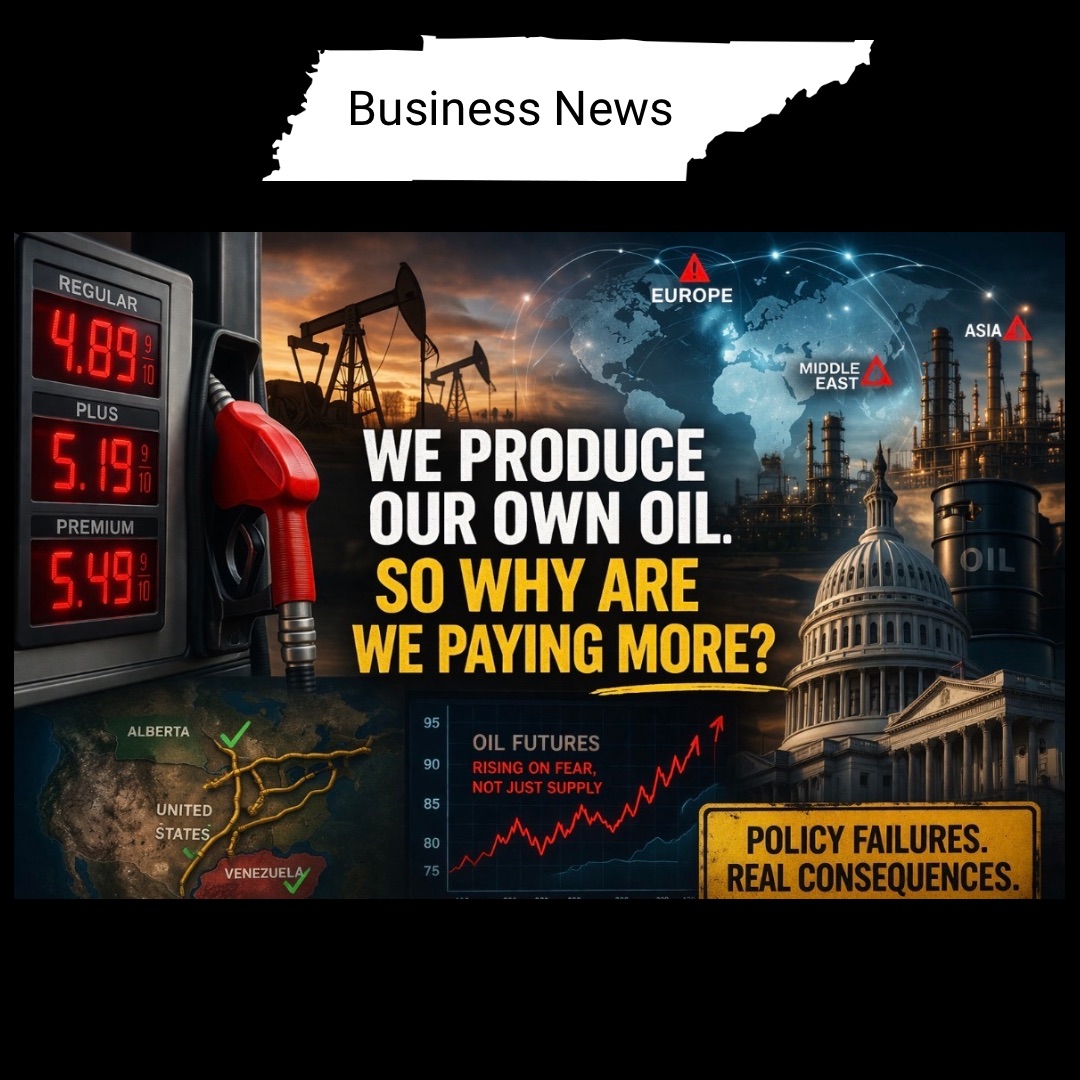

Pull up to the pump today and you might see a price that feels like a lie.

We produce a lot of our own oil. Nothing has physically changed in America. No supply has been cut. No pipeline is down. So why are you paying more the same week Iran makes headlines?
The answer is not one thing. It is a system. And understanding it also reveals some policy failures that nobody in Washington wants to own right now.
First: Oil is priced globally, not locally.
It does not matter that the barrel under your tank came from Texas. What matters is what the next buyer anywhere in the world is willing to pay for the next barrel. When Japan, South Korea, India, and Europe all start worrying about Strait of Hormuz supply disruptions at the same time, they bid more aggressively for available supply. That global price moves, and we pay it too. The Texas producer does not sell you oil at a Texas discount. They sell at the world price, because that is what the market will bear.
This is not a conspiracy. It is how commodity markets work everywhere. It is also why “we produce our own” does not insulate you from global shocks the way most people assume it should.
Second: Speculators move faster than tankers.


There are traders who will never touch a barrel of oil who make money betting on where prices are going. When geopolitical risk rises, they pile into oil futures contracts, and prices move faster than any actual supply change. You are partly paying for the fear of a disruption, not just the disruption itself. That is real, it is legal, and it is accelerated by every headline.
Refining is the bottleneck nobody talks about.
Gasoline is not crude oil. It has to be refined, and we do not have unlimited refining capacity. We lost significant capacity during COVID and have not rebuilt it. In states like California, capacity has actively shrunk because of regulatory pressure and a long term political bet that gasoline demand was about to collapse due to electric vehicles.
Gavin Newsom crippled oil and gas in his state to the extent that companies are paying massive amounts to shut down.
That bet was wrong. Or at minimum, it was premature.


People are still driving. The American vehicle fleet turns over slowly. Gasoline is still essential for the overwhelming majority of Americans today, and will be for years. The transition to EVs, whatever you believe about its timeline, has not happened fast enough to justify treating refining infrastructure as expendable.
So when a global price spike hits, we cannot easily ramp up the conversion of crude into gasoline to meet demand. The system is tight. It snaps instead of flexing.
The contradiction no one in Washington will say out loud:
We spent years being told by regulators, by investors, and by politicians that gasoline demand was in permanent decline. That was the justification for not building or expanding refineries. Environmental permitting made new capacity nearly impossible anyway. The political signals from both parties, but especially one of them, pointed clearly away from long term investment in refining.
But Americans did not stop driving. The fleet did not electrify on the projected schedule. Demand held.
So now we have a system with global pricing that moves instantly, speculators who accelerate every move, and refining infrastructure that was deliberately not expanded because we were told it would not be needed.
When fear hits the market, that system does not absorb the shock. It transmits it directly to your wallet.
So is it gouging?
Some of it, at the margins, probably yes. Price transparency laws and state attorneys general exist for exactly that reason and should be used aggressively when retailers exploit the moment beyond what cost changes justify.
But the structural problem is not gouging. It is that we built a fragile system by design, based on projections that did not come true, and the people who made those projections have never been made to account for what it costs you every time you fill up.
The next time a politician tells you gasoline prices are a simple supply and demand story, ask them why we have not built meaningful new refining capacity in decades. Then watch them change the subject.
This is exactly the time with heavy and sour oil coming on from Venezuela, Alberta hopefully moving toward expanded production and connection in the oil sands etc for America to cut the regulatory nightmares and expand refining capacity.
Clayton Wood is a Knoxville pastor, lawyer and contributing writer for TriStar Daily.