
By: Steve Gill
There are few things conservatives love more than free markets. There are also few things conservatives fear more than open-ended government spending programs. Universal school vouchers manage the remarkable feat of being both at the same time.
It’s like discovering that your favorite steakhouse has merged with the Department of Motor Vehicles, sacrificing, both quality and efficiency for “free” government money.
The theory behind universal vouchers is simple enough. Competition improves quality. Give parents money, let them shop for schools the way they shop for breakfast cereal, and educational excellence will bloom across Tennessee like dogwoods in April.
Except education isn’t breakfast cereal. For one thing, nobody spends six hours a day trapped inside a box of Raisin Bran trying to teach algebra to students squirming from being denied even a few precious moments reviewing TikTok videos.
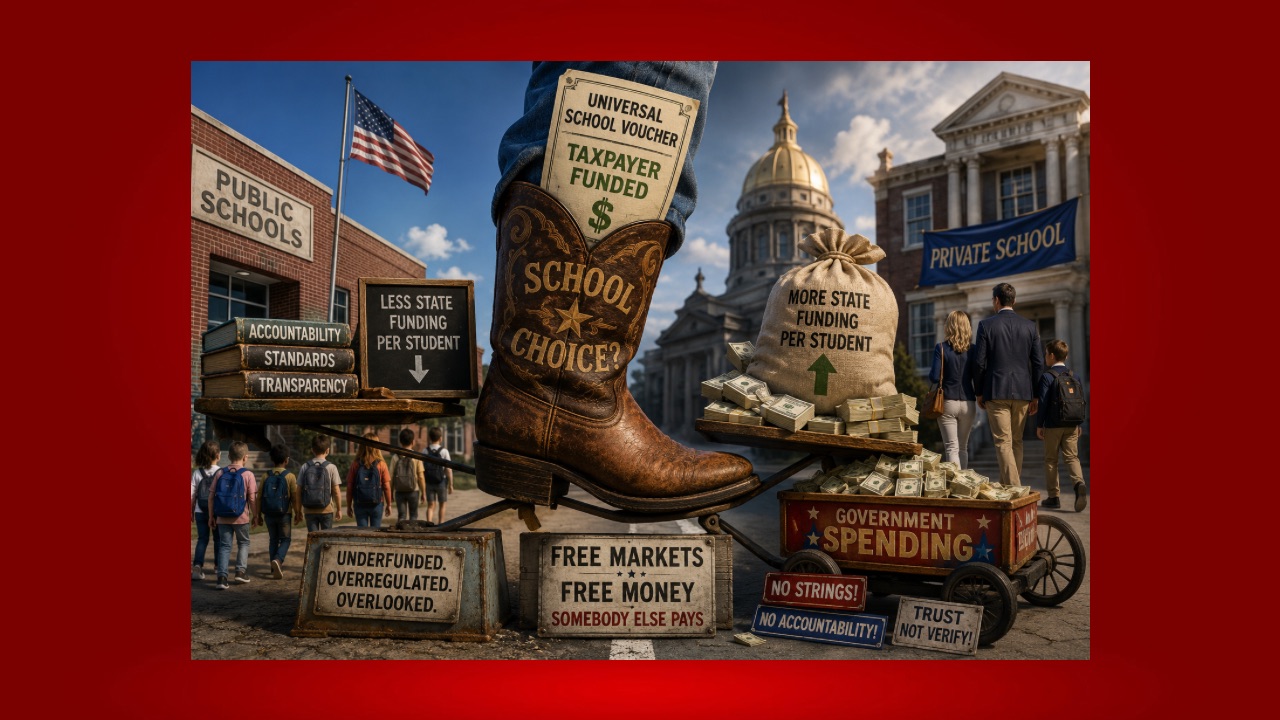
Tennessee’s ongoing voucher debate has produced an unusual political spectacle: conservatives arguing with other conservatives over whether this is school choice or simply another entitlement program wearing cowboy boots and carrying a copy of Milton Friedman’s “Capitalism and Freedom.”
The concern isn’t entirely irrational.
Under Tennessee’s Investment in Student Achievement formula—TISA—many local school districts receive less state funding per student than the amount attached to a fully funded voucher. Take Sumner County, one of Tennessee’s successful suburban districts north of Nashville. For the 2025-26 school year, its total TISA allocation is approximately $279 million, with roughly $220 million coming from the state. Metro Nashville Public Schools and Williamson County Schools were found to be receiving significantly less state funding per student compared to the voucher amount, with some projections indicating a difference of over $2,000.
The irony is thick enough to spread on biscuits at Loveless Cafe.
We are told that public schools are inefficient dinosaurs. Yet about 40% of those same districts receive LESS state support per child than the state is provides to families leaving those schools for their vouchers. There’s a reason why collegiate sports teams with little or no NIL money find it hard to compete with programs that are flush with cash. Yet, we expect subsistence level public schools to compete effectively in the new voucher era.
If government spending is terrible, why are we trying to do more of it?
Arizona offers a cautionary tale. What started as a program projected to cost around $60 million eventually exploded to more than $700 million within two years. It looks like Tennessee is following the same path. Budget hawks who usually worry about federal deficits suddenly discovered that fiscal discipline apparently applies only to programs somebody else likes.
Universal vouchers began looking less like educational reform and more like Medicare for prep school tuition to students already enrolled in the private school to begin with. Most of the money being provided as vouchers are flowing into the pockets of those whose children are already in private schools. They already made a “choice”, now they are being rewarded for it at the expense public schools.
Then there’s accountability. Public schools operate under a regulatory regime that would make the North Korean border patrol blush. Standardized tests. Teacher evaluations. Public reporting requirements. Improvement plans. Audits. Committees. Committees to oversee other committees. Mind- numbing bureaucracy on steroids.
Private schools receiving public dollars often operate under very different rules. And little accountability.
Conservatives spent decades insisting on standards, accountability, and measurable outcomes. Now some appear ready to say, “If taxpayers fund it, don’t ask too many questions.” Apparently, “trust but verify” has become “trust and don’t bother to look closely.”
Public schools also serve a purpose beyond teaching multiplication tables and explaining why teenagers should not eat Hot Cheetos for breakfast, or snack on Tide Pods to draw clicks on TikTok. They’re civic institutions.
Burkean conservatives traditionally understand this. Institutions matter because they bind communities together through shared experiences and obligations. Public schools are often where future nurses, mechanics, engineers, accountants, and occasionally state legislators, first learn to coexist with people unlike themselves.
Universal vouchers risk accelerating educational sorting by income, culture, and geography.
And if Americans have demonstrated anything in recent years, it’s that what we desperately need is fewer opportunities to retreat into ideological gated communities.
Politically, universal vouchers present Republicans with a balancing act usually attempted only by circus performers and members of Congress.
Suburban Republican voters generally like their neighborhood schools. Many moved specifically to communities with strong public systems. They support choice in principle until they suspect their own schools may lose resources, their own taxes may rise, or their own districts may shoulder a larger burden. Suddenly, the revolution doesn’t seem quite so revolutionary.
Meanwhile, the academic evidence remains stubbornly unimpressed by everyone’s talking points. Studies from states such as Louisiana and Indiana have found that voucher students often perform worse academically than comparable peers in public schools, particularly in reading and mathematics. Other studies show mixed outcomes at best, in spite of huge taxpayer investment.
Educational miracles have a frustrating tendency not to show up when promised. And when that happens, the politicians have already moved on and the lobbyists are collecting a check for the “next big thing.”
Perhaps most uncomfortable is who benefits. In states with universal programs, many new participants were already enrolled in private schools. Families who had long managed tuition payments received a taxpayer-funded discount.
Meanwhile, low-income and rural families often faced barriers involving transportation, limited private school availability, and selective admissions policies. Somehow nobody discusses those facts as they collectively pat themselves on the back for “passing vouchers”!
It turns out that “choice” is easier when you already have plenty of choices. None of this means Tennessee should abandon educational innovation.
Targeted programs aimed at low-income families or students with special needs deserve consideration. Education Savings Accounts, like those pushed by President Trump, with meaningful accountability standards could represent a reasonable compromise. Charter schools can provide public alternatives that preserve both choice and transparency.
But conservatives should remember an old truth. The first duty of government is not to prove ideological purity. It is to exercise prudence.
Sometimes the question isn’t whether an idea sounds good at a think-tank luncheon or on a campaign mailer.
The question is whether taxpayers can afford it, whether it actually works, and whether the institutions it disrupts are more valuable than the reformers are willing to acknowledge. Because once government creates an entitlement, it rarely if ever disappears.
And if Tennessee merely replicates the spending habits of the federal government, coupled with the accountability standards of a witness protection program, and the sales pitch of a late-night infomercial, we may discover that the real lesson wasn’t about school choice at all.
It was about human nature. Everybody loves free markets, and free money. Especially when somebody else is paying.
Steve Gill is editor and publisher of TriStar Daily, and a product of public schools K-JD.