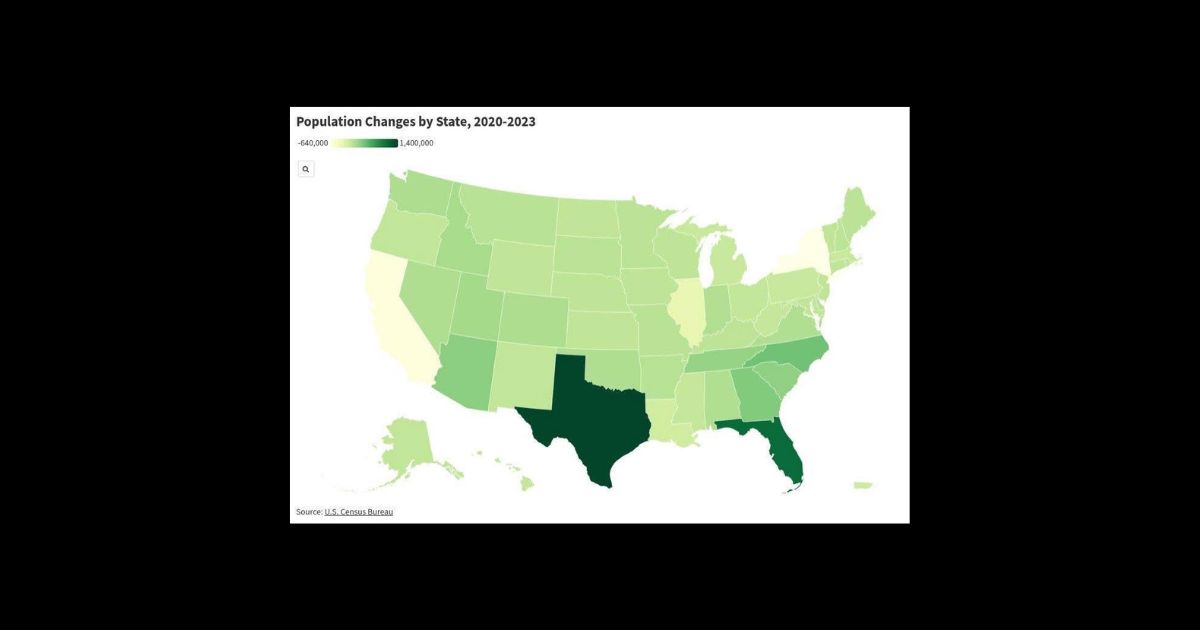

There is a version of this essay that is partisan cheerleading. This is not it. What I am interested in is describing, as accurately as I can, the structural trajectory of American political power over the next decade, because I believe that trajectory is now moving faster and in more durable directions than most political commentary acknowledges. The argument I am making is not that Democrats will never win again.
The argument is that the threshold for Democratic victory in a presidential election and in the fight for the House of Representatives is about to become, for structural reasons largely outside either party’s short-term control, very close to impossible in any ordinary political environment.
That conclusion rests on four interlocking developments, each of which I have written about separately. What I have not done until now is lay them together in sequence and show what the compounding of all four produces. The sequence is a census that was historically wrong in a single political direction, a population migration that has not reversed and largely cannot, a Supreme Court ruling that removed the legal architecture protecting a Democratic gerrymander dressed in civil rights language, and the collapse of the one historical precedent for a Democratic coalition capable of overcoming structural map disadvantages: the Obama coalition of 2008, built on a promise of racial healing that the party’s own institutional choices made impossible to deliver and therefore impossible to repeat.
Work through each act carefully. Then look at what they add up to.
Act One: The Census That Was Not Accurate
Start with what is not in dispute. The Census Bureau’s own post-enumeration survey, released after the 2020 count, found statistically significant overcounts in eight states and undercounts in six others. The overcounted states were Delaware, Hawaii, Massachusetts, Minnesota, New York, Ohio, Rhode Island, and Utah. Seven of those eight voted for Joe Biden. The undercounted states were Arkansas, Florida, Illinois, Mississippi, Tennessee, and Texas. Five of those six voted Republican.
The numbers behind those findings are not rounding errors. Florida was undercounted by approximately 750,000 people. Texas by more than 500,000. Tennessee by roughly 340,000, representing nearly 5 percent of the state’s actual population. On the other side, New York was overcounted by approximately 670,000. Minnesota was overcounted by more than 216,000.
The consequences for congressional apportionment were concrete and lasting. Florida did not receive two additional House seats it had earned. Texas lost out on at least one additional seat. Minnesota retained its eighth congressional seat by a margin, under the official count, of 89 people. The post-enumeration survey found that Minnesota had been overcounted by more than 216,000 individuals. Minnesota has been operating with a congressional seat it does not deserve for six years, and that seat has been exercising real votes on real legislation affecting real Americans.
For context: the 2010 census found no statistically significant net overcounts or undercounts anywhere. Not one state. We know how to do this correctly because we did it correctly fourteen years ago. The 2020 errors were not the product of an impossible task. They were the product of choices about methodology, partnerships with outside organizations whose incentives did not align with accuracy, and an enforcement environment the Commerce Department’s own Inspector General documented as tolerating falsification. Enumerators who falsified information were not always terminated. Their work was not always redone. Bonuses were sometimes paid regardless.
I will say plainly what the data permits saying: the errors ran systematically in one political direction, were historically unprecedented in scale, were concentrated in the states with the highest political stakes for apportionment and occurred in an environment where the incentive structure for cheating was high and the consequences were effectively nonexistent. Whether that reflects deliberate orchestration or simply the predictable output of a broken accountability system, the political effect was identical.
The 2030 census will be conducted under different conditions. It will be scrutinized in ways the 2020 count was not. The current administration has different incentives, and the memory of 2020’s documented failures creates political pressure for methodological rigor that did not exist before those failures were admitted. A census conducted with genuine accountability will not produce the same systematic errors in the same direction. When it does not, the baseline for apportionment shifts toward something closer to reality.
Act Two: A Decade of Feet Voting
Lay the census correction on top of a second layer: one of the largest domestic migration events in American history.
Since 2020, Americans have moved in enormous numbers from high-tax, high-regulation, high-cost states toward lower-cost states with different governance philosophies. The IRS migration data, which tracks actual economic humans filing returns from different states year over year rather than relying on surveys, documents massive income flows out of California, New York, Illinois, and New Jersey into Florida, Texas, Tennessee, North Carolina, South Carolina, and Arizona. This is not a marginal trend. It represents wealth and population transfer at a scale that reshapes state economies.
I have watched this from Knoxville. Tennessee was among the most severely undercounted states in the 2020 census, missing nearly 5 percent of its actual population. At the same time, the state has been absorbing enormous inflows of people and capital from states whose governance model they chose with their feet to leave. Home prices in Knoxville have risen at rates among the fastest in the nation, driven substantially by buyers arriving from out of state with the proceeds of sold homes in more expensive markets. The state that was undercounted in 2020 has grown beyond even the corrected estimate, and the 2030 census will find a Tennessee closer to 8 million people than 7 million.
The states people are leaving are not recovering. New York City has not returned to its pre-COVID population by its own municipal projections. Illinois has been losing population for years and its pension crisis ensures the fiscal conditions driving that departure will not improve. California is experiencing net population loss for the first time in its modern history. San Francisco’s office vacancy rate, school enrollment decline, and city budget shortfalls document not a temporary disruption but a structural reorganization of who lives there.
High mortgage rates slowed the migration but did not reverse it. The pattern is established. When rates normalize, more movement will follow the trail already blazed. The people who sold $3 million homes in California and moved to Tennessee do not need a mortgage. They are already here. Their income is here. Their children are enrolled in our schools. And they did not move to adopt the political preferences of the places they left.


Combine baseline correction with genuine migration and the apportionment math for 2030 is not speculative. It is the output of a demographic reality that has already happened. Texas gains 4 to 5 House seats. Florida gains 2 to 3. Tennessee, North Carolina, Georgia, Arizona, Utah, and Idaho each gain one. California loses 4. New York loses 3. Illinois, Minnesota, Michigan, Pennsylvania, Wisconsin, Oregon, and Rhode Island each lose one. That is a structural shift of 10 to 12 House seats from safe Democratic to safe Republican states before a single map is drawn.
Act Three: The Legal Firewall Falls
Then comes the ruling some political commentary has dramatically underestimated.
Louisiana v. Callais was decided 6-3, the conservative majority intact, with Justice Alito writing for the court. The ruling did not technically strike down Section 2 of the Voting Rights Act. It did something more surgical. It reinterpreted Section 2 to require proof of intentional racial discrimination before a court may order a remedial map. That is a standard Congress explicitly rejected when it amended the law in 1982. It is also a standard that is nearly impossible for plaintiffs to meet.

The political commentary on this ruling focused on the obvious: Black representation in majority-minority districts in the South is now legally vulnerable in ways it has not been since 1965. That is true and it matters. But it is not the full story, and the part of the story that did not get told is the part that matters most for partisan mathematics.
The majority-minority district requirement under Section 2, as Democrats and civil rights organizations interpreted and enforced it over thirty years, did two things simultaneously. It created majority-Black districts that reliably elected Black Democrats. And it required concentrating Black voters, who vote Democratic at 85 to 90 percent rates, into a small number of packed districts. That packing made the surrounding districts whiter, more suburban, and more favorable to Republicans. What was defended in court as a civil rights protection was, in its partisan effect, a Democratic gerrymander. Concentrating the most reliable Democratic voters into a handful of safe seats created exactly the kind of packed-and-cracked map that, if Republicans had drawn it, would have been challenged as discriminatory.
Republican mapmakers understood this dynamic. Democratic voting rights lawyers understood it too, which is why the strategic value of majority-minority districts was rarely discussed openly. The districts produced Black members of Congress, which was politically essential to the Democratic coalition. They also produced surrounding districts that were structurally safer for Republicans than they would have been if Black voters had been distributed more broadly. Both effects were real. Only one was discussed.
What Louisiana v. Callais changes is not just Louisiana’s map. It removes the legal constraint that forced Republican legislatures in the South to maintain those packed minority districts. Republican-controlled legislatures in Georgia, Alabama, Mississippi, Louisiana, Tennessee, and South Carolina can now draw maps that disperse Democratic voters across more districts. This sounds like it would create more competitive races. In states where Republicans have structural advantages in non-urban areas, competitive does not mean Democratic. It means Republican-leaning seats where Democrats have a somewhat better chance than in districts drawn entirely around them, but Republicans still win.
Map the practical consequences across the South. Georgia currently sends 9 Republicans and 5 Democrats to the House. Remapped without Section 2 constraints, Georgia plausibly sends 11 or 12 Republicans. North Carolina currently sends 10 Republicans and 4 Democrats. Aggressive remapping without racial composition requirements could produce 11 or 12 Republican seats. Louisiana and Alabama each have one majority-minority Democratic seat that is now legally unprotected. Mississippi has similar exposure.
Add the Southern remapping potential to the apportionment shift and the number of effectively locked Republican seats is not 220. It is 228 to 232. That is before you count the redistricting advantage in states that are gaining seats and where Republican legislatures will draw those new seats with no federal constraint and every political incentive to draw them safely.


Act Four: The Promise That Cannot Be Recycled
The structural map argument has a natural Democratic counterargument: a strong enough candidate can overcome structural headwinds. It has happened before. Barack Obama in 2008 won 365 electoral votes in a year when the Republican brand was damaged by an unpopular war and a financial collapse. He carried Indiana, which had not voted Democratic since 1964. He carried North Carolina for the only time between 1976 and today. He won Virginia for the first time since 1964. If a candidate can do that, the map does not determine the outcome.
This counterargument is correct as historical description and wrong as forward projection, for reasons that go deeper than normal partisan cycling.
Obama’s crossover performance was built on a specific psychological dynamic that was real, legitimate, and not recyclable. He offered Republican crossover voters something that no other candidate in American history had offered: the ability to demonstrate to themselves and their communities that they were capable of evaluating a Black candidate on merit, that they were part of a historic national moment, and that the country they believed in could actually do what it had always claimed to be able to do. That is not cynicism about their motives. Many of those voters were genuinely moved. But the mechanism was singular. It depended on a first moment that had not yet occurred. It cannot be a second moment.
Obama also carried a specific promise that millions of voters across racial lines understood and believed: that his election represented the beginning of American racial maturity. Not the end of racism, but a turning point. A post-racial seriousness in which the country could evaluate individuals rather than groups and move past the divisions that had defined it since its founding.
That promise was not delivered. And the failure was not simply Obama’s personal failure, though his administration made choices that contributed to it. It was the failure of the political and institutional infrastructure that had grown up around the civil rights movement and that found, when legal segregation ended and formal discrimination became illegal, that it faced an institutional survival problem.
Organizations, legal frameworks, academic departments, grant structures, and political careers built around fighting racism had to either declare victory and dissolve or redefine racism in ways that made it permanent, unfalsifiable, and structurally embedded rather than individual and addressable.
They chose the latter. Critical race theory in its academic form and diversity, equity, and inclusion in its institutional form are the administrative expressions of that redefinition. Racism became not an act committed by individuals but a property of systems, and systems are permanent by nature, which means the organizations fighting systemic racism are permanent by necessity, and the people funding them have a reliable cause in perpetuity.
By every measurable indicator, racial tension in America increased during and after the Obama presidency. Gallup’s race relations polling showed consistent deterioration from 2013 onward. The percentage of Americans calling race relations very bad reached levels not seen since the Rodney King era. This was not driven primarily by white supremacist activity, though that existed. It was driven by the mainstreaming, through elite institutions, legacy media, and social media simultaneously, of a framework that treated permanent racial grievance as the only honest response to American history and treated disagreement with that framework as evidence of the racism it claimed to fight.
The political consequence for 2032 and beyond is this: the crossover voter who pulled the lever for Obama in 2008 believing it meant something watched fifteen subsequent years produce the opposite of what they voted for. They watched their children come home from universities having been taught that their country was irredeemably corrupt and that their own identity was a category of oppression. They watched institutions they had trusted adopt a framework that called them racists for disagreeing with it. They are not crossing over again. Not for any Democratic candidate who cannot credibly separate themselves from that institutional inheritance. And no candidate who can win a Democratic primary in the current environment can credibly make that separation, because the primary electorate is controlled by the institutional infrastructure that made racial healing impossible in the first place.
The Hispanic shift of 2024 is the clearest evidence that the damage extends well beyond white Republican voters. Hispanic voters, who were supposed to be the foundational demographic of the emerging Democratic majority, moved toward Republicans by double digits in a single cycle. The exit polling and focus group data tell a consistent story: Hispanic working class voters, particularly men, do not recognize themselves in the grievance framework the Democratic Party adopted. They came to America to build something. The ideology that told them the system was rigged against them did not match their lived experience or their aspirations. They moved, and they have not moved back.
The Arithmetic of 2032
Put the four acts together and run the numbers honestly.
Post-2030 apportionment from accurate census counting of actual migration: 10 to 12 seats move from states Democrats win safely to states Republicans win safely, simply because of where people actually live. This happens before any legislature touches a map.
New seat construction in gaining states: 6 to 8 seats that do not currently exist will be drawn from scratch by Republican legislatures in Texas, Florida, and smaller gaining states. Blank canvas seats built to elect Republicans.
Southern remapping after Louisiana v. Callais: 8 to 12 seats currently locked into majority-minority configurations become available for redrawing. Republicans can disperse those concentrated Democratic voters, turning safe Democratic seats into competitive or lean-Republican seats.
The total structural shift is therefore 24 to 32 seats, and the three mechanisms are genuinely distinct. The census moves existing seats between parties by moving apportionment between states. The new seat construction creates Republican seats that never existed. The Section 2 collapse converts Democratic seats that were legally protected into contested or Republican terrain.
The reasonable central estimate for safe Republican House seats after 2030 redistricting is 228 to 232. Call it 230. In a 435-seat chamber where 218 is the majority threshold, a structural Republican floor of 230 means Democrats must win essentially every competitive district in the country while holding every marginal seat they currently occupy. That performance level has been achieved once in the past forty years, in 2008, under conditions that included a financial collapse, an unpopular war, record Democratic enthusiasm, and a candidate who offered something no candidate had ever offered before or can offer again.
In the Electoral College, the same apportionment shift adds electoral votes to states Republicans already win and removes them from states Democrats already win. The structural Republican advantage in electoral votes increases by 15 to 20 before a single swing state votes. The path to 270 for Democrats in 2032 requires running the table in Arizona, Georgia, Pennsylvania, Michigan, Wisconsin, and Nevada simultaneously while preventing Republican breakthroughs in Virginia and Minnesota, both of which have been trending Republican in presidential years. There is no margin for error in any single state. There has not been a Democratic coalition capable of that performance since 2012, and the map in 2032 will be structurally harder than the 2012 map by the margin of an entire reapportionment cycle.
The candidate who could theoretically overcome those headwinds does not currently exist within the Democratic primary electorate. Obama was not simply a talented politician. He was a singular historical figure offering a specific psychological permission structure to crossover voters at a specific unrepeatable moment, running on a promise of racial healing that the party’s subsequent institutional choices made impossible to honor. A Democrat who runs in 2032 on genuine distance from the grievance framework is the only candidate who could access crossover Republican votes at meaningful scale. That candidate cannot currently survive a Democratic primary, because the primary electorate is controlled by the institutional infrastructure that would have to be repudiated.
The trap closes on itself. The structural map requires crossover voters to win. Crossover voters require a candidate who can credibly separate from the grievance framework. The grievance framework controls the nomination process. The nomination process therefore cannot produce the candidate the structural map requires.
The One Honest Caveat
The structural case holds under specific conditions: an accurate 2030 census, continued migration trends, Republican map aggressiveness in gaining states, and continued Democratic coalition instability with working class and Hispanic voters. If any of those conditions fails, the argument weakens proportionally. A census conducted with the same accountability failures as 2020 would partially reset the baseline problem. A genuine Republican governance collapse between now and 2032, of the magnitude of 2008, could produce wave conditions that override structural headwinds. Texas is getting younger, more Hispanic, and more urban in its major metros simultaneously, and if Texas Democrats ever build ground game infrastructure proportionate to their raw population numbers, the map advantage becomes meaningless in that specific state.
These are real counterarguments and they deserve acknowledgment. But they are low-probability outcomes against a structural trend that has been building for a decade and is now being locked in by a Supreme Court ruling, a migration reality, and a census correction that are all moving simultaneously in the same direction.
This is not an argument about certainty. It is an argument about structure. The structure, as it is currently developing, produces an outcome where Democratic presidential victories require a candidate who does not currently exist, performing at a level achieved once in the past thirty years, against a structural map deficit that will be the largest in the post-World War II era.
What This Means
James Carville told you the Democratic strategic answer to this analysis on a podcast, and he was honest enough to say explicitly that the answer had to be hidden from voters. Grant statehood to Washington D.C. and Puerto Rico for four reliable Democratic Senate seats. Pack the Supreme Court to neutralize the judicial branch. Reopen the border and grant mass amnesty to reshape the eligible electorate before the 2030 census locks the map for a generation. His advice to Democratic politicians: do not run on it, do not talk about it, just do it.
Do not run on it. Do not talk about it. Just do it.
That sentence is the tell. When your plan requires hiding it from the voters you claim to represent, you already know the voters would not choose it. And it confirms that the structural analysis in this essay is correct, because people who believe they are winning do not need to hide their strategy. They announce it.
The SAVE Act, the filibuster fight, the redistricting arms race, the census methodology battles: these are not individual policy disputes. They are all theaters in a single conflict over the structural composition of American electoral politics for the next generation. The side that understands them as connected is the side that wins the long game.
The map is the message. Read it carefully.