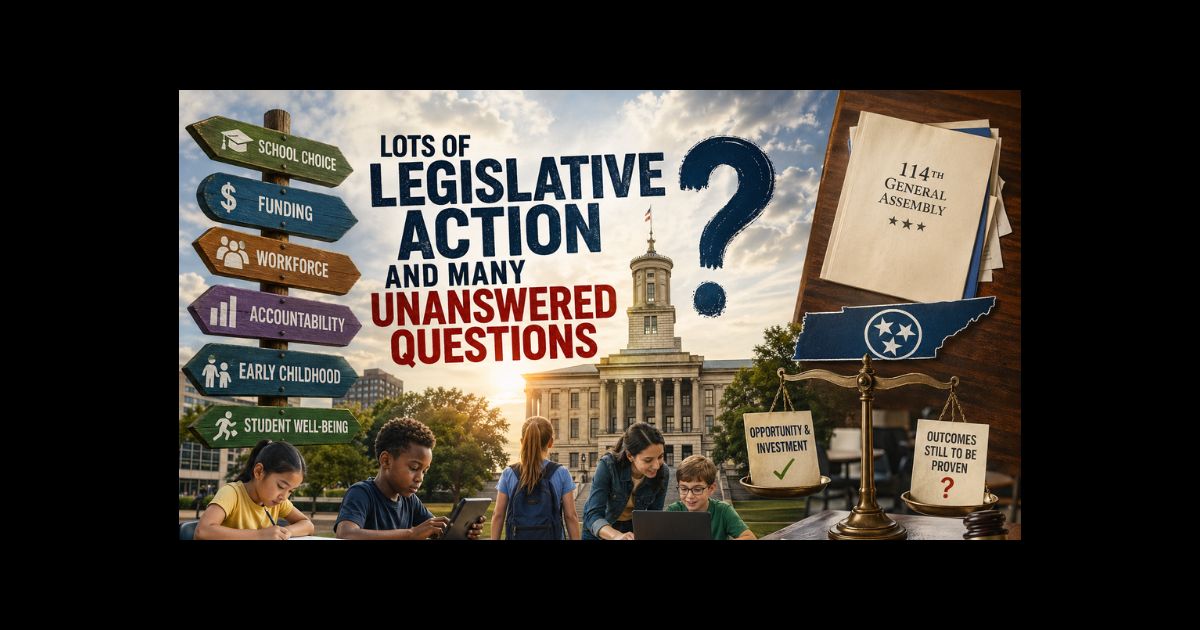

The 114th General Assembly did not sit still on education. Lawmakers advanced a wide slate of policies—expanding school choice, increasing funding, addressing workforce shortages, and tightening accountability. By any measure, it was an active session. Nearly 600 education bills were filed, and over 200 passed.

The most consequential decision was clear: Tennessee expanded its Education Freedom Scholarship program from 20,000 to 35,000 students. That is no longer a pilot. It is policy. Lawmakers also added funding protections for school districts losing enrollment and required reporting on why students leave—an acknowledgment that growth in one area creates pressure elsewhere.
At the same time, the state continued to make a significant investment in public education. The budget includes hundreds of millions in new funding, continued progress toward a $50,000 starting teacher salary, and targeted support for summer learning and student mental health. Whatever the rhetoric, the legislature did not completely walk away from traditional public schools this year.
Did it do enough? We believe there is more to do and more work ahead for us. We encourage educators and parents to be a critical source of information and a voice for our state’s children, especially those in their communities. To strengthen their position as an education expert and resource, regularly provide information, updates, and feedback to the policymaker’s office. Take advantage of all channels, including letters, emails, in-person meetings, town halls, and site visits. We desperately need a debate among the Governor candidates to hear their plans for education, and we need them to hear from K-12 educators and parents.


There was also a strong push in the legislature on early childhood and workforce issues. Expanding Pre-K access, creating apprenticeship pathways for educators, allowing supervised youth employment in childcare, and cutting duplicative regulations are practical steps to address a real problem: not enough adults in the system to meet growing demand.
On the student side, lawmakers focused on the day-to-day experience. New policies limit excessive screen time in the early grades, require local districts to set clearer rules for device use, and increase physical activity requirements for elementary students. These are not headline-grabbing changes, but they reflect a growing recognition that how students learn matters as much as what they learn.


Accountability was addressed—though unevenly. The state put new pressure on underperforming virtual schools, including the possibility of closure following sustained low performance. At the same time, adjustments to testing requirements in existing ESA programs introduced greater flexibility, raising familiar concerns about whether outcomes will remain comparable across systems.
The legislature also stepped directly into governance. The decision to enable state intervention in Memphis-Shelby County Schools signals a willingness to take control when results lag. Whether that produces better outcomes—or simply shifts responsibility—depends on execution, not on intent. We all remember the Achievement School District’s billion-dollar boondoggle.
Other measures rounded out the session: faster student record transfers, protections for learning pods and microschools, updates to funding formulas, and new requirements for curriculum transparency and the display of historical documents.
Taken together, this session was defined by movement. More choice. More funding. More state involvement. More flexibility in some areas and more structure in others. Individually, most of these decisions are defensible. Collectively, they indicate that the system is still in transition.
The legislature has expanded opportunity and increased investment simultaneously. That is the easy part. The harder part comes next—proving that these changes, taken together, improve student outcomes. Because passing bills is measurable, the success of legislation cannot yet be proven.
JC Bowman is the executive director of Professional Educators of Tennessee and Contributing Editor for TriStar Daily.