
The recent changes to Tennessee’s Education Savings Account (ESA) program mark a strategic shift rather than a sweeping expansion, focusing on redefining accountability rather than broadening access. Some policymakers wanted to use the legislation to expand ESA vouchers further, but the Tennessee Senate said no this year.

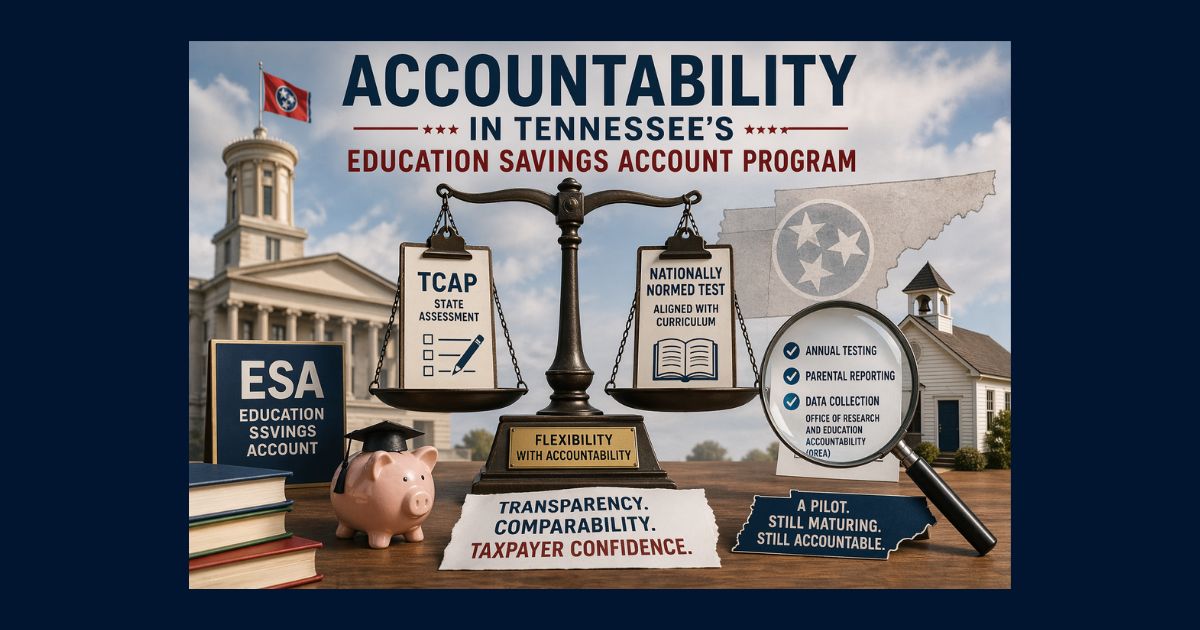
With the passage of House Bill 1881, lawmakers have moved away from a single testing standard, embracing flexibility in assessment options for private schools participating in the program. Participating private schools can now opt for either the state’s TCAP exam or a nationally normed test aligned with their curriculum.
Proponents of this change argue that it is a pragmatic solution. Concerns were raised about ESA students undergoing dual testing, but no conclusive data have been found to substantiate them. Advocates for HB 1881 contend that the TCAP does not necessarily reflect the instruction students receive, making a streamlined approach a reasonable aim.
However, this shift carries significant implications. When Tennessee launched its ESA pilot, it promised that public funding would include clear accountability—enabling straightforward comparisons. That clarity was essential for policymakers and taxpayers to assess the program’s effectiveness. House Bill 1881 undermines that clarity.


Although it retains annual testing, parental reporting, and data collection through the Office of Research and Education Accountability (OREA), the departure from a common assessment standard complicates “apples-to-apples” comparisons. Even supporters of the bill acknowledge this challenge. Perhaps Tennessee should revisit its standards and assessment strategy when the next Governor takes office in January 2027.
This is particularly important given the recent Comptroller’s evaluation, which showed that ESA students are improving yet still lag behind their public-school counterparts. Faced with these findings, lawmakers opted to adjust the framework rather than reinforce comparability.


It’s important to note that flexibility isn’t necessarily a step back. Schools use varied educational approaches, and a uniform test may not adequately reflect those distinctions. There’s a compelling argument that aligning assessment with instruction can yield more meaningful insights into student learning. Still, the program was identified and passed as a pilot project, and the state just said its pilot project did not meet its objectives.
Nonetheless, the critical issue remains: while students continue to be tested, will the state—and the public—be able to interpret the results clearly enough to guide future policy? And who will be able to interpret and compare the results in plain English for taxpayers?
In this regard, HB 1881 doesn’t resolve the accountability debate; it simply reconfigures it. Tennessee continues to exercise oversight, using a gentler approach that focuses on aggregated reporting and selective TCAP sampling rather than universal comparisons.
The ESA pilot continues without expansion, reflecting an understanding that the program is still maturing. However, this evolution shouldn’t compromise clarity.
If the aim is to foster long-term confidence in school vouchers, transparency cannot be merely procedural; it must be straightforward and comprehensible. We need transparency and accountability for all tax dollars. Tennessee has opted for flexibility this year, but it must ensure that this flexibility does not devolve into ambiguity.
JC Bowman is the executive director of Professional Educators of Tennessee. He is the Contributing Editor of TriStar Review.