
By: Chris Hughes
There are many legitimate arguments about school choice, and despite the best efforts from the Left, it’s really hard to argue against the idea that parents should have the opportunity to make the best choices for their own child’s education. Today there are more education options available than ever: public, private, charter, homeschool, etc.
We can debate whether Tennessee’s voucher program improves student outcomes, increases competition, provides real choice, or weakens traditional public schools. But there is one argument that should no longer be disputed, because the numbers have settled it.
The oft-stated claim that public schools always receive more state funding per student than voucher recipients is simply not true. In Tennessee, the arithmetic reveals the reality; a reality that can be and should be corrected.
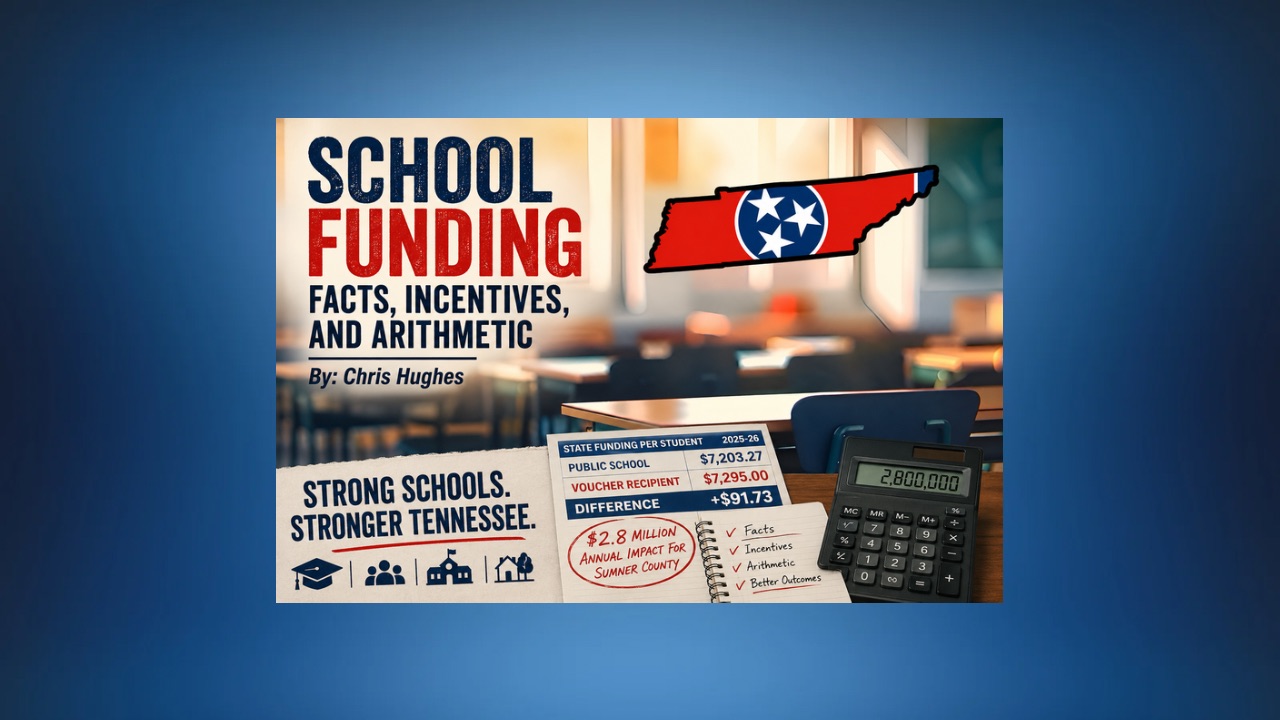
The state’s Education Freedom Scholarships provide approximately $7,295 per participating student during the 2025-26 school year. Those scholarships are funded entirely by the state treasury. There is no county commission appropriation. There is no local tax match. The state writes the whole check.
Meanwhile, under Tennessee’s Tennessee Investment in Student Achievement (TISA) formula, many public school districts receive less than that voucher amount in state funding for each student they educate. Not slightly less. Substantially less.
This is not conjecture. It is not political rhetoric. It is not an attack line crafted by opponents of school choice. It is the direct result of Tennessee’s own funding formula.
My home county of Sumner County is one of Tennessee’s fastest-growing suburban districts, located just north of Nashville. For 2025-26, the Sumner County Department of Education is expected to receive approximately $279.3 million through TISA. Of that amount, roughly $219.7 million represents the state’s contribution. The district serves approximately 30,500 students.
When you divide the State of Tennessee’s share of education funding by student enrollment, the numbers tell a troubling story. Sumner County receives just $7,203.27 per public school student in state funding, which is less than the $7,295 voucher amount the state is providing for a student attending private school.
In other words, the State of Tennessee is allocating $91.73 more per student to private school vouchers than it provides for a student attending public school in Sumner County.
When you apply that funding gap across nearly 30,500 students enrolled in Sumner County Public Schools, the difference becomes staggering.
If Sumner County students were funded at the same per-student level as private school voucher recipients, our public school system would receive approximately $2.8 million more each year from the State of Tennessee. Simply put, Tennessee is currently providing private school students with higher funding than students attending our public schools right here in Sumner County.
Yet Sumner County’s teachers still show up every morning. The buses still run. The buildings still operate. Students are still taught. How?
Because local taxpayers make up the difference, this is where the debate often becomes clouded by political slogans rather than economic reality.
TISA was deliberately designed around fiscal capacity. Districts with stronger local tax bases receive a smaller percentage of state funding because policymakers assume those communities can shoulder a larger share of educational costs themselves. Poorer districts receive a larger state contribution. Whether that approach is wise is a separate debate.
The consequence of this funding disparity is undeniable. Across Tennessee, many public school districts are educating students with less state funding per child than the state is now providing through private school vouchers. That number is approaching 40% of school districts statewide and could continue to grow.
The burden does not simply disappear. In communities where public schools receive less funding, local taxpayers are often forced to make up the difference, creating increased pressure on counties and municipalities to consider raising taxes simply to keep their public school systems competitive.
What makes this even more concerning is the irony at the center of the debate. One of the single greatest factors influencing property values in any community is the strength and reputation of its public school system. Strong schools create stronger neighborhoods, attract families, drive economic development, and directly protect home values.
In other words, regardless of whether you personally have children in public schools, every property owner has a vested interest in ensuring their local public school system remains strong, competitive, and properly funded.
According to analyses of TISA allocations, approximately 39 percent of Tennessee school districts receive less state funding per pupil than the voucher amount. Districts such as Sumner County, Williamson County, and Metro Nashville have all been identified as receiving lower state contributions per student than the amount attached to an Education Freedom Scholarship.
Some projections showed that certain districts were receiving more than $2,000 less per student from the state than voucher participants were.
Again, these are not inventions of advocacy groups. They emerge from Tennessee’s own calculations. Critics of this observation often shift the discussion by pointing out that public schools receive local and federal funds in addition to state dollars. That is true. But it entirely misses the point.
The comparison being made in legislative debates has always been about the state’s commitment. Vouchers are 100 percent state-funded. Public schools must combine state aid with local revenue to provide the same educational services. Is that fair?
When state leaders argue that vouchers merely provide families with “the same funding” the state spends on public school students, they are either misinformed or not telling the truth. For many districts, the state actually spends more on the voucher recipient. The state data confirms it. The public school system then relies on local taxpayers to bridge the gap.
Conservatives like Steve Gill and JC Bowman have argued that one of the most dangerous habits in public policy is the tendency to ignore trade-offs and pretend that incentives do not matter. Numbers become subordinate to narratives. Facts become inconveniences to be explained away.
Bowman has made the case that changes to state funding were needed, but TISA would lead to local property tax hikes across the state. Gill has pointed out that vouchers are becoming subsidies and need better guardrails to prevent betraying our supposed commitment to strong public schools. Both are correct.
Education policy is especially vulnerable to trade-offs and misapplication of facts as policy. People become so invested in defending their preferred system that they stop asking the most basic question: What do the numbers actually show? And more importantly, are the policies we adopt producing results in the form of better academic achievement by Tennessee school kids?
In Tennessee, the numbers show that many public schools educate children with fewer state dollars than students receiving vouchers. No dispute.
Reasonable people may conclude that this is justified. Others may see it as inequitable. Some may argue that the entire funding structure should be reconsidered.
But honest people should at least acknowledge reality. The first duty of education is to teach the truth. The first duty of public policy is to confront it.
No serious discussion about school funding can continue while pretending that two plus two equals five. In Tennessee, there is no genuine dispute left on this point.
Many public school districts receive less state funding per student than the amount provided through vouchers. The arithmetic has already rendered its verdict. The only question remaining is what are we going to do about it?
Chris Hughes is a product of public schools as are his two children, both of whom graduated from Hendersonville High School. He’s a candidate for the State House of Representatives from Sumner County.