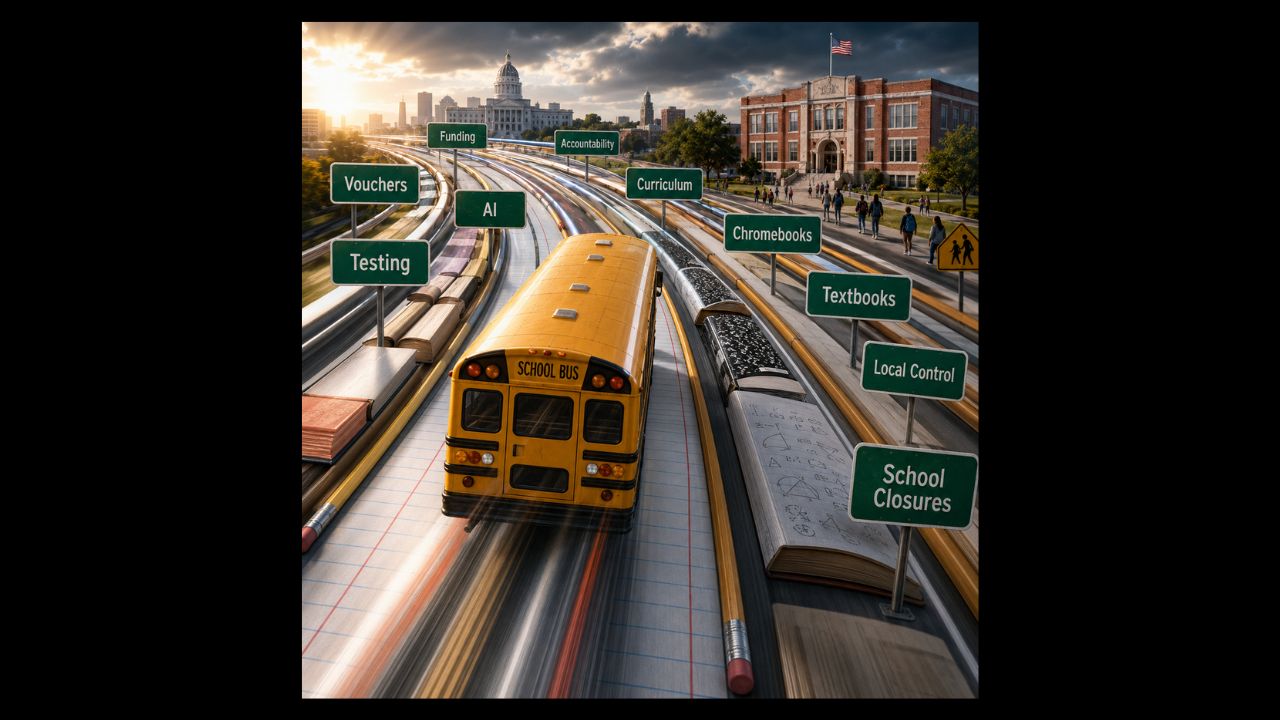

Public education debates are fast-paced and can be overwhelming. Issues such as vouchers, curriculum choices, testing, accountability, AI, Chromebooks, and textbooks come up quickly. Each issue has its own headlines and opinions. When the public focuses on one topic, another appears, leaving many people tired and wondering whether it’s worth their attention. You may not notice, but you are caught up in the race.
What if these debates are not just random issues in education? What if they are part of a bigger picture that needs our focus? This question is important, and its effects reach far and wide.
Many Americans focus on current education issues, but we need to understand how laws, court decisions, demographic shifts, and varying levels of funding influence education policy. It can be tempting to see each policy decision as a separate event, but when we look at them together, the real debate becomes clear. That’s where it really matters.
Schools across the country are facing serious problems. They are grappling with budget cuts, declining enrollment, and a shortage of teachers. Many school buildings are old and in need of repair, and people are losing faith in these institutions. Communities are starting to wonder whether schools can truly meet their educational needs. However, they often forget that the alternatives can be much worse.
As trust in local schools declines, more people are calling for state involvement. The state’s role increases, school management changes, local control is lost, and accountability measures are revamped. Alternative education methods are becoming more popular and accepted, like a new driver winning a NASCAR race. However, there is still little evidence that the state can effectively handle these challenges.


People have different opinions about whether recent changes are necessary improvements or a concerning shift away from local control. What matters is to look at the series of events that brought us to this point.
Many citizens believe the current public school system has failed by the time changes are made. This often leads to discussions that focus more on shutting down or completely changing schools instead of solving the real problems that communities face. Keep fighting, even when you are tired.

Change is a constant necessity in public education. Schools must adapt to new demographics, workforce needs, and technology. Families want schools to prepare students for a rapidly changing world. We cannot afford to stay the same. But if we rush ahead without a plan, we risk losing our way.
Every reform should raise an important question: What do we want to keep as we move forward? Schools do more than teach subjects; they prepare students to be good citizens, encourage civic responsibility, promote critical thinking, and enhance cultural understanding. Schools are central to community life. They host concerts, sports events, elections, and meetings. In many areas, schools are the most visible public institutions, leading to a key, often overlooked, question: What happens when they close?


Public schools are essential for education, community involvement, and the economy. They are often located in prime real-estate locations in growing neighborhoods. These buildings are often built to last, showcasing craftsmanship that is hard to find in modern construction. As public assets, they have benefited from years of taxpayer funding and financing.
When schools close, what happens to their buildings? Who decides to close or merge schools? What factors influence those choices? Who manages the properties of the closed schools, and how do we protect taxpayer money? Should local communities have a voice in what happens to these spaces? Are the decisions about closures based only on education, or are other motives involved?
Asking these questions is crucial for good management of public resources. Communities have the right to know that decisions about public assets are clear, logical, and focused on their long-term benefit.
Education policy goes beyond just what happens in classrooms. It shapes future workers, prepares citizens for self-governance, and reflects the values of our society for generations. This is likely why people feel so strongly about education debates—they’re not just about schools; they are about our shared future.
Let’s not forget testing. Standardized assessments often prioritize rote memorization over critical thinking, creating a disconnect between educational standards and actual learning outcomes. Competing priorities and limited resources can hinder teachers, making it difficult to meet students’ needs effectively.
The real challenge is making sure we don’t simplify complex issues into catchy headlines or political slogans. Instead, we should look at how individual choices connect with larger trends that affect governance, community identity, public investment, and educational opportunities.
Some reforms will yield positive results, while others might lead to unexpected problems. Honest people can disagree on which reforms will have an effect and what that will mean for a local community. Democracy works best when citizens ask careful questions before making decisions they can’t undo.
We should not only think about today’s urgent issues when considering the future of public education. We need to have a broader discussion about how we teach our children, maintain public trust, protect community resources, and ensure our choices now benefit future generations.
Sometimes, the most pressing questions are the ones that don’t make the headlines. They are the ones we haven’t yet taken the time to ask. If you don’t get it right, children and communities will lose. Education, much like life in the fast lane, can drive you to lose your mind.

JC Bowman is the executive director of Professional Educators of Tennessee and Contributing Editor to TriStar Daily.