
There was a time when the people of Memphis believed their public schools could not possibly become any more complicated. Then the Bill & Melinda Gates Foundation arrived with $90 million, several consultants, at least 14 PowerPoint presentations, and what experts call “transformational reform,” which almost always means someone is about to need a spreadsheet.
This all began in 2009, when the Gates Foundation launched the Intensive Partnership for Effective Teaching initiative in Memphis. The idea was simple: if you create enough teacher evaluations, performance metrics, data dashboards, accountability rubrics, and strategic frameworks, a child somewhere will eventually learn algebra by accident.
At roughly the same time, State Collaborative on Reforming Education — known by the comforting acronym SCORE — appeared in Tennessee education politics like a highly organized cousin who shows up for Thanksgiving with a pie chart. Founded by Bill Frist, SCORE promised bipartisan, data-driven educational improvement. Americans love “data-driven” solutions because they sound scientific, even when no one can explain what the data actually says except a consultant billing $400 an hour.
Enter David Mansouri, who joined SCORE in 2010 and steadily climbed the ranks to become president and CEO. Mansouri became one of Tennessee’s most recognizable education reform advocates, speaking the language of modern policy professionals, where every sentence includes phrases like “stakeholder alignment,” “pathway readiness,” and “evidence-based outcomes.” He is also a friend and does some admirable work, especially in workforce readiness.
Meanwhile, in the Tennessee legislature, Mark White emerged as a leading voice on education. White, a former teacher and principal, chaired key committees, served on the SCORE board for a time, and became one of the state’s most influential lawmakers on education. In Tennessee education circles, this is the equivalent of being the drummer in a garage band: everybody knows you, but nobody outside the building understands exactly what you do.


The Gates Intensive Partnership for Effective Teaching initiative officially ended around 2016. And here is where things become awkward.
A major RAND evaluation later concluded that despite all the reforms, restructurings, measurements, strategic interventions, and meetings involving bottled water and miniature muffins, the initiative did not substantially improve student achievement or graduation rates overall.

To summarize: Memphis received enough philanthropic funding to purchase approximately 18 million dry-erase markers, and the measurable academic gains were somewhere between “limited” and “please stop asking.”
But in fairness, the initiative did produce lasting changes. There are now vastly improved teacher evaluation systems, expanded residency programs, and enough educational jargon floating around Shelby County to stun a herd of oxen. And now, in 2026, we arrive at the inevitable climax of every modern education reform story: a state takeover and an oversight board.


After years of dysfunction and frustration in Memphis-Shelby County Schools, Tennessee leaders established a new oversight structure. Speaker Cameron Sexton appointed Mansouri to the board, making him the only non-Shelby County resident on the board.
This has raised questions among local residents, mainly: “Wait, didn’t these same people already reform the schools once?”
That is the magical thing about education reform in America. Failure is never terminal. In fact, it is often considered qualifying experience.
If a restaurant serves terrible food for years, we do not normally say, “These people should oversee more restaurants.” Yet in education policy, unsuccessful reforms merely evolve into newer ones with longer names and better logos.
One can only imagine the future meetings. There will be consultants and strategic frameworks. Someone will say “student-centered outcomes” at least 11 times before lunch. There will probably be a PowerPoint slide with upward arrows in optimistic shades of blue.
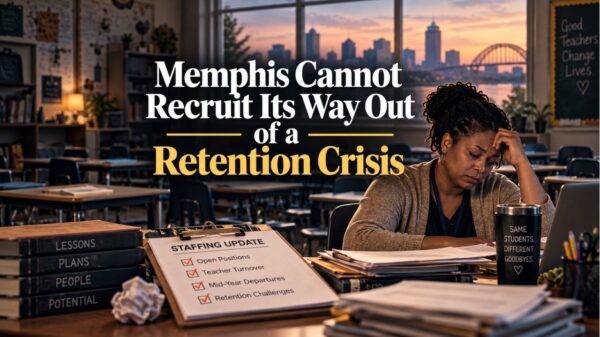
And somewhere in Memphis, an exhausted classroom teacher will quietly wonder whether any of this has even the slightest connection to teaching children to read.
The true genius of modern education reform lies in its ability to create an endless cycle. Foundations fund advocacy groups, which influence legislation. State policymakers create oversight boards, which recommend reforms. Consultants evaluate reforms, and foundations fund the next round of reforms. It is essentially a perpetual-motion machine fueled entirely by acronyms.
Meanwhile, parents continue to ask radical questions like: “Can my child read?” “Is the school safe?” “Why does the district office need three executive directors of strategic coherence?”
Nobody knows. But there will definitely be another report.
JC Bowman is the executive director of Professional Educators of Tennessee and a Contributing Editor to TriStar Daily.