

A recent study completed by the University of Tennessee, Knoxville’s Boyd Center for Business and Economic Research and the nonpartisan nonprofit Voices for a Safer Tennessee, which advocate for increased restrictions on gun ownership, shows firearm injury and death are on the rise statewide.
“Firearm deaths have actually increased 60% over the last 10 years,” Erin Rogus, Voices for a Safer Tennessee board member, told News 2 in Nashville.
Researchers compiled data from organizations like coroners’ offices across the state and the Tennessee Bureau of Investigation for the study. Their findings showed there were 1,622 firearm-related fatalities in Tennessee in 2023, including 881 suicides and 667 homicides. (By the way, Memphis set an all-time high record for homicides in 2023, with the Memphis Police Department (MPD) recording 397 total homicides, which included 344 intentional murders.)
The study shows Tennessee ranked No. 5 in the U.S. for firearm homicides per capita in 2023. The study also calculates an estimated economic impact for Tennesseans who are victims of gun violence.
“It accounts for the value of lost life, the lost earnings, lost productivity, but it also takes into account medical costs and costs of law enforcement. These total costs added up to nearly $4.5 billion in 2023, more roughly about $600 per Tennessee resident,” Rogus added.


The data also breaks down firearm deaths by race, age and county; and shows death by firearm is now the leading cause of death for Tennessee children.
The report seems to downplay the fact that over HALF of total firearms deaths come from suicide, 881 out of a total 1622 fatalities in 2023. In the United States, an average of nearly 27,000 Americans die by firearm suicide every year. According to Centers for Disease Control and Prevention (CDC) data, 27,593 individuals died by firearm suicide, which accounts for the vast majority (about 62%) of all gun-related deaths in the country.

The lethality of using a firearm to commit suicide makes it a preferred choice in many cases. Nevertheless, it is also clear that some people who are prevented from attempting suicide with a firearm will substitute another lethal means and end their lives. In many Asian countries, where possession of firearms is severely limited, there are still relatively high levels of suicide achieved by other means. The rate at which this substitution occurs is not known. For laws that increase or decrease firearm suicides, the effects on total suicides may be smaller and harder to detect, particularly in a country like the US that has so many citizens possessing weapons.
The study reveals a broad disparity in gun deaths by homicide versus suicide by race. 83% of gun deaths among blacks are a result of homicide, versus only 17% by suicide. For whites, the numbers are almost an exact reversal: 16% homicide to 84% suicide.


It is also interesting that the split between suicide and homicide fatalities among those under 35 also reverses the overall numbers. Under 18, homicides account for 69% of deaths; ages 19-34 the homicides are 62%.
Based upon the homicide deaths among blacks, as revealed by the study, it is clear that black-on-black gun homicides are what is really driving the cost of gun violence in Tennessee. First, 35% of the gun fatalities in Tennessee were black, although blacks make up about 16% of the state population. The overwhelming number of those were homicides of blacks under 35, and overwhelmingly male. The Tennessee numbers track with national trends.
Second, Shelby County recorded one of the highest gun fatality rates in the state at 32.8 per 100,000 residents from 2014 23. Most of those fatalities were young black males killed by other young black males. (Tennessee counties with very small populations also recorded some high rates, mainly because a few incidents have a greater statistical impact.)
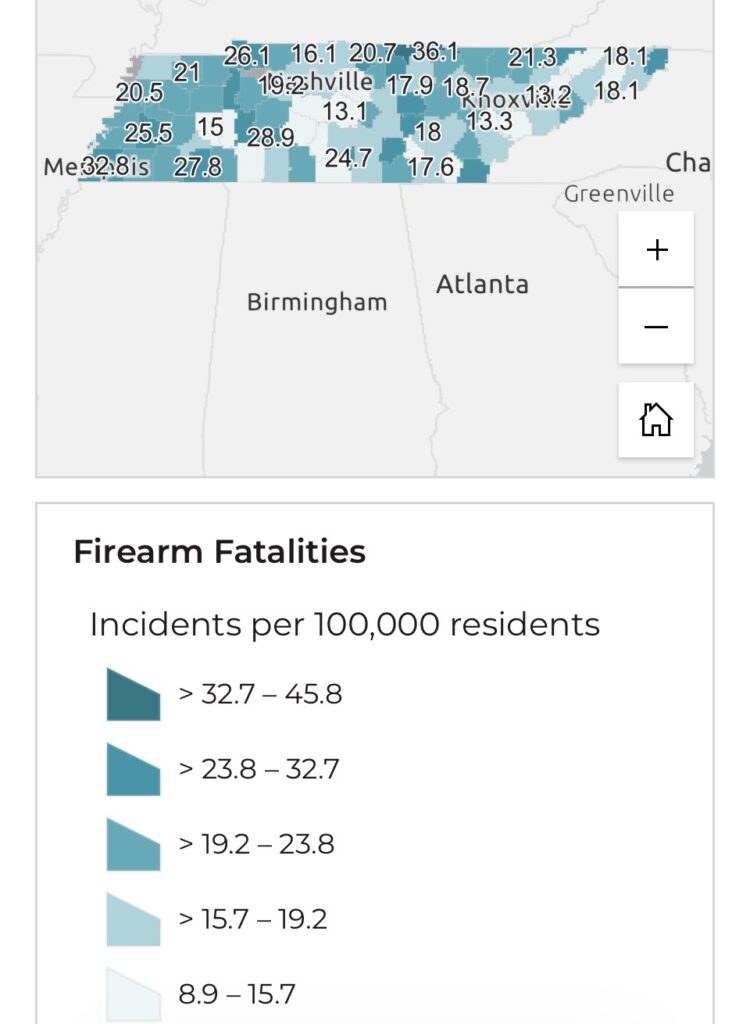
Memphis has historically faced one of the highest per capita firearm homicide rates in the U.S., but the city has experienced a major decline in gun violence recently. Following an estimated spike to roughly 397 homicides in 2023, the city saw a significant 30% drop to around 296 killings, with further double-digit reductions in overall violent crime reported in 2025. Some of that reduction may be based upon the federal storage in law-enforcement in Memphis in Fall 2025.
With over 50% gun ownership in Tennessee, and a population of 7.4 million people, it appears the real cost to Tennessee from firearms deaths comes not from the guns but from those who are using them for criminal purposes, and in many cases, obtaining the guns illegally in the first place.
The overwhelming majority of gun owners in Tennessee are not a problem. Yet the Voices for a Safer Tennessee group is advocating policies to rein in the rights of law-abiding gun owners rather than focus on the more difficult and uncomfortable source of the real problem of gun violence. Aggressive law enforcement in Memphis, despite catch and release judges who refuse to punish violent offenders, has recently shown a path to reducing the impact of gun violence. Increased application of justice for those who steal guns, use them to commit crimes, or possess them after a felony conviction could further dramatically reduce the costs to taxpayers in Tennessee.
Perhaps the University of Tennessee and the Boyd Center could focus on that aspect next.
Steve Gill is editor and publisher of TriStar Daily.