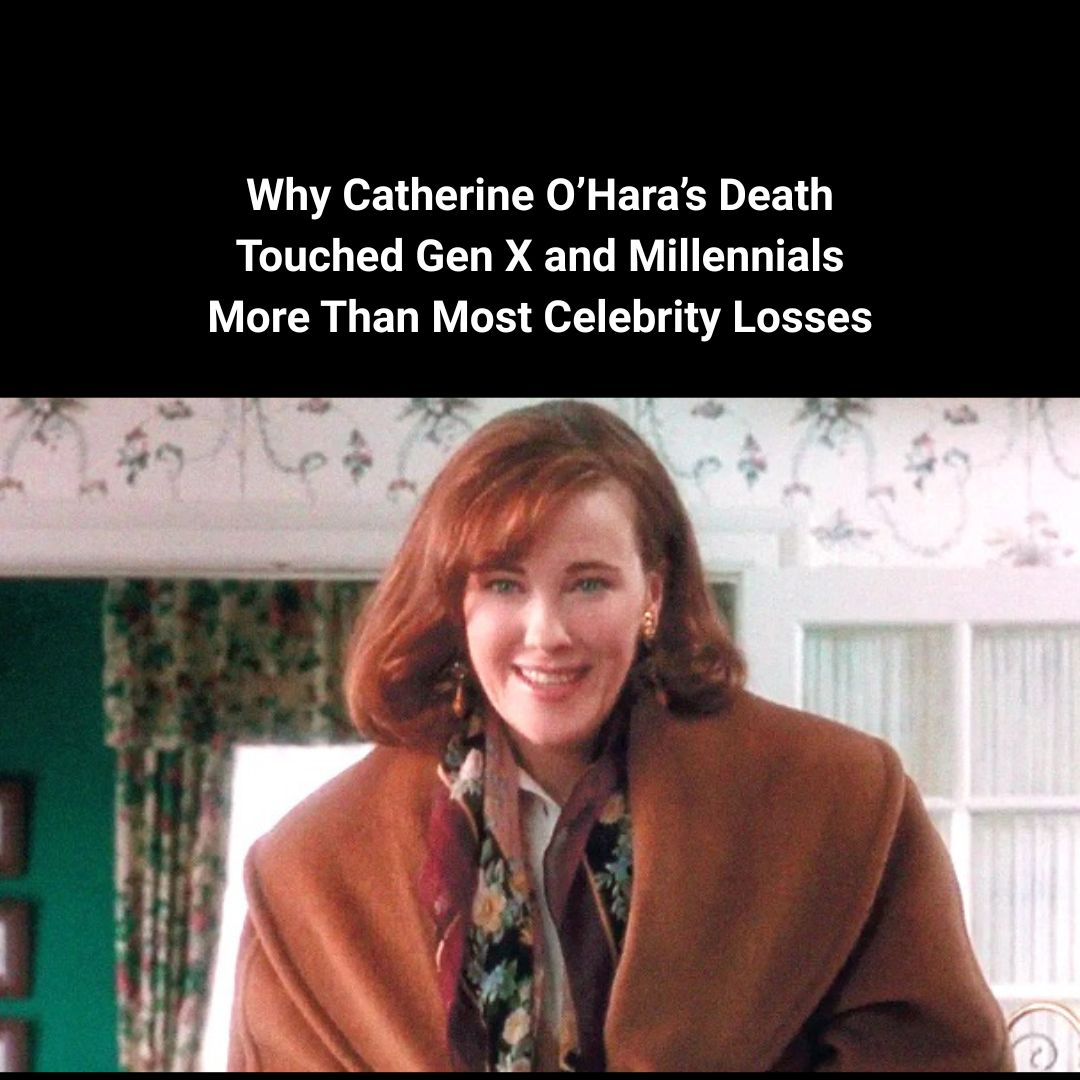
In the wake of the death of actress Catherine O’Hara, thousands of tributes were created by her fans and former co-stars. Something felt different and more personal about this celebrity’s death, and it took me a few days to realize why.
O’Hara passed at the age of 71, but in my mind, as well as millions of others, she will forever be the flawed but lovable middle-aged mom who we first met in the 1990 blockbuster hit: “Home Alone.”
Details emerged about O’Hara’s extremely rare disorder, which caused her organs to be on the reverse side of a typical body, and may have contributed to her death. After I read that update, I watched replays of her most memorable scenes, including the final scene where she reunites with Kevin, I asked myself, “Why does this feel personal?”
My oldest brother — who has never once texted me about an actor’s death — even reached out to say, “Can’t believe Kevin [McCallister]’s mom died.” That same reaction echoed across social media from Gen Xers like him and from “elder” Millennials like me — the so-called Xennials — who flooded articles and posts on every major platform with nearly identical sentiments.
For Baby Boomers, the quintessential on-screen vision of Christmas was embodied by Jimmy Stewart and Donna Reed in Frank Capra’s “It’s a Wonderful Life”, a film that remains a perennial fixture on lists of the greatest Christmas movies of all time.
For Generation X and Millennials, O’Hara’s role in Home Alone became as much of a Christmas tradition as the other elements we’ve always associated with the holidays. I am nearly the exact same age as Macaulay Culkin, and at the to Mr of the film’s release, his character was instantly relatable. Of course, my generarion also grew up watching National Lampoon’s Christmas Vacation just as much, if not more often, but there has always a distinct difference between Chevy Chase and Beverly D’Angelo’s antics as the Griswalds vs. O’Hara’s perseverance through every parent’s worst nightmare as Kate McCallister.
Unfortunately, it took most of us the better part of 40 years to fully appreciate O’Hara’s outstanding performance. At first glance, it’s easy to dismiss her character as a typical slapstick comedy bad mother — selfish, shrill, even careless. But as the story unfolds, that judgment melts away. What we’re left with is a nightmare that feels uncomfortably familiar, and a frantic, unapologetic devotion that stops feeling like acting by the film’s second half.
We stopped watching a movie and started seeing our own lives on screen. We recognized our own mothers in her voice — the threats to apathetic airline ticket agents, the panic, the ferocity — and we knew, without question, that our moms would bulldoze anyone or anything that stood between them to right their wrong and get home to save their child.
That’s why Catherine O’Hara’s death hits differently. It isn’t just the loss of a beloved actress or a familiar face from our childhood screens. It feels like the quiet end of a Christmas tradition — and, more painfully, a preview of what many of us are beginning to confront in real life. We’re not just grieving over a film that will never feel quite the same; we’re bracing for the day when holidays themselves change forever — not because an actor is gone, but because our own parents are.
Losing America’s Christmas movie mom pales in comparison to losing our own mom someday. We know that it will be harder than we’re ready to admit. For our friends who have already experienced that loss, we struggle to imagine how they’ve been able to enjoy Christmas since then.


Last year, a fan of O’Hara’s posted a video of a run-in with her, where they raved about her work and asked, “Out of all of your roles, which one do you hope you’re remembered for?”
“Mother to my children,” O’Hara answered. Her sons, Luke and Mathew Welch, now see just how much the world appreciated her warmth and talent.
Rest in peace, Catherine O’Hara. And thank you — not just for the laughs, but for the love you helped us recognize at an early age, long before we understood how fragile life really is.
Author