Decorum, Hypocrisy, and the
Long Unraveling of the Affordable Care Act
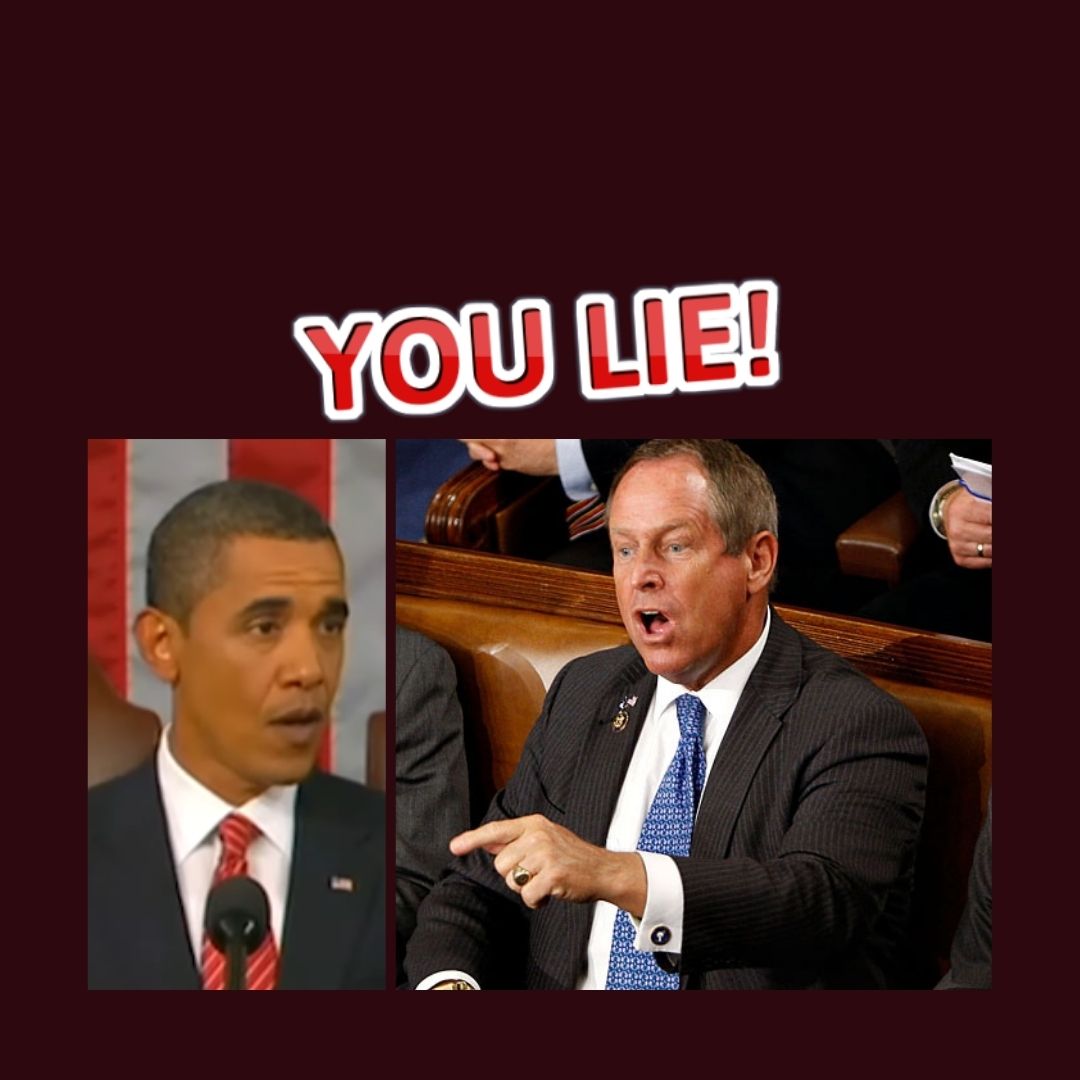
On the evening of September 9, 2009, a single outburst changed American political history not because of what was said, but because of what that moment revealed about who was actually lying. President Barack Obama stood before a joint session of Congress to make the case for his signature legislative achievement, the Affordable Care Act. He was forceful, polished, and emphatic. He promised Americans that if they liked their healthcare plan, they could keep it. He promised that illegal immigrants would not receive benefits. He promised costs would come down.
When Rep. Joe Wilson of South Carolina shouted “You lie!” from the Republican side of the chamber, the reaction was immediate and thunderous. Both parties condemned him. Republicans called it “totally disrespectful.” Democrats demanded a formal censure. The press treated it as a shameful breach of the most sacred rules of democratic discourse. Wilson apologized that same night, called the White House, and was formally rebuked by the House of Representatives anyway.
Fifteen years later, we now know something important: on the broad questions of what the ACA would actually do to ordinary Americans, Joe Wilson was closer to the truth than the President of the United States. And the story of how we got from that chamber in 2009 to where we are today is a story not just of broken promises, but of deliberate deception, willful ignorance, manufactured decorum, and a political class that holds the rules of civility as a weapon to be deployed against its opponents while exempting itself entirely.
Part One: The Decorum Double Standard
One Man, Two Words, and a Formal Rebuke
The “You lie!” incident deserves to be understood in its full context. Wilson shouted his objection when Obama said: “There are also those who claim that our reform effort will insure illegal immigrants. This, too, is false. The reforms I’m proposing would not apply to those who are here illegally.”
The bipartisan condemnation was swift and total. Republican Senator John McCain called it “totally disrespectful,” saying there was “no place for it in that setting or any other.” Republican Rep. Jerry Lewis said that “anybody who would catcall the president of the United States addressing this body is very, very inappropriate.” Democratic Senate Majority Whip Dick Durbin called it “crude and disrespectful.” Rep. Jim Clyburn said Wilson had “gone beyond heckling.” Rep. Alcee Hastings declared it “a major breach of decorum.” Wilson was formally rebuked by the House and nearly censured. His Democratic opponent raised over a million dollars in the days that followed.
The reaction was, in the language of the moment, appropriate. There are norms of conduct in the chamber, and shouting at a sitting president during an address is a breach of those norms. On that narrow question, the critics were not wrong.
But a precedent was established in that room: a single spontaneous outburst, immediately apologized for, by one Republican, was treated as a civilizational offense requiring formal congressional rebuke.
Fast Forward: Democrats at Trump’s Addresses
Now hold that standard up against what Democrats have done during Donald Trump’s addresses to joint sessions of Congress, and the double standard becomes almost impossible to defend.
At Trump’s 2025 joint address, Rep. Al Green stood up and shouted “Mr. President, you don’t have a mandate” within minutes of Trump beginning to speak. When Johnson gaveled him and ordered him to sit, Green refused. He was physically removed from the chamber by the sergeant-at-arms. Other Democrats throughout the speech repeatedly shouted “Those are lies!” at the president. Rep. Rashida Tlaib brought a whiteboard and held up messages reading “NO KING” and “LIES.” Several members turned their backs on Trump, displaying the word “RESIST” on their shirts. Others walked out. Still others held up protest signs they had been explicitly told not to bring by their own leadership.
At Trump’s 2026 State of the Union, delivered just last night, the scene was arguably worse. House Minority Leader Hakeem Jeffries had specifically instructed his caucus to show decorum and bring no signs, warning them against “unforced errors” after reviewing polling that showed the previous year’s theatrics had backfired. Democrats defied him anyway. Reps. Ilhan Omar and Rashida Tlaib heckled Trump repeatedly throughout the speech, shouting about immigration enforcement, screaming “You have killed Americans,” and demanding the release of the Epstein files. Rep. Al Green (again) held up a sign. Rep. Gwen Moore called the president a “tyrant.” Rep. Lois Frankel stood and pointed furiously at the president.
Speaker Mike Johnson‘s verdict: “We asked everybody to maintain decorum and they couldn’t do it, they couldn’t contain it for two hours. They were absolutely shameful.”
One Republican congressman. One spontaneous outburst. Immediately apologized for. Formally rebuked.
Dozens of Democratic congressmembers. Coordinated, premeditated, defiant disruption across multiple years. Celebrated by their base.
One standard applied to one party. A completely different standard applied to the other. That is the definition of hypocrisy.
The Pelosi Footnote
No accounting of congressional decorum theater is complete without Nancy Pelosi’s performance at the 2020 State of the Union. Seated directly behind Trump, on national television, she waited until he finished speaking and then, in a premeditated and choreographed act, tore his speech in half in front of the cameras.
The response from Democrats: applause, celebration, memes. The response from the media: widespread praise. There was no censure, no formal rebuke, no bipartisan condemnation. Joe Wilson shouted two words in an unplanned moment of passion, apologized within hours, and was formally sanctioned. Nancy Pelosi planned and executed a theatrical act of contempt in the most formal legislative setting in the country, and was cheered for it.
The rules are not actually about decorum. They are about who gets to deploy them.
Part Two: The Lie at the Heart of the ACA
If You Like Your Plan, You Can Keep It
The Affordable Care Act was sold to the American people on the strength of a promise repeated dozens of times, in dozens of settings, across years of political campaigning: “If you like your doctor, you will be able to keep your doctor. If you like your health care plan, you’ll be able to keep your health care plan. Period. No one will take it away, no matter what.”
Obama said it at the American Medical Association. He said it in weekly radio addresses. He said it at town halls in Ohio and Wisconsin and Virginia. The White House website repeated it. He said it at Rose Garden events, at rallies, in press conferences. He said the word “period” to emphasize that there would be no exceptions, no asterisks, no fine print.
It was not true. And there is evidence that at senior levels, people who helped craft this message understood it might not be true.
When the ACA’s minimum coverage requirements took effect, millions of individual market plans that predated the law were deemed non-compliant and canceled. By the end of 2013, at least seven million consumers had received cancellation notices. They had not done anything differently. Their plans simply no longer met the government’s new requirements for what a health insurance plan must include. PolitiFact named Obama’s promise its “Lie of the Year” for 2013. Obama eventually apologized on NBC, telling Chuck Todd he was sorry that people had been misled.
But an apology after the fact, after millions had already lost coverage they had chosen and paid for, does not change what the original promise was, or what it was designed to accomplish. The promise was meant to neutralize the most powerful objection to a sweeping government mandate: the fear of disruption. It worked politically. It just wasn’t true.
What It Actually Did to Real People
This is not an abstract policy failure. For millions of ordinary Americans people who had made careful decisions about their healthcare, who had chosen specific plans for specific reasons, who had built family budgets around specific premium costs and deductible structures the ACA was a direct and unwelcome disruption to their lives.
Individual health plans purchased outside the employer system, the kind that self employed people, small business owners, and those between jobs depended on, vanished. I was one of those people. I worked at a nonprofit that at the time did not offer health insurance plans. The plans that replaced them cost more every month. The deductibles rose sometimes dramatically meaning families paid significantly more out of pocket before any coverage kicked in. Networks narrowed, meaning doctors they had chosen and trusted were no longer covered. They were paying more for less, by government mandate. When I write about this lie and the damage it caused, it impacted me personally.
The ACA’s benefit mandates required that all plans cover things that many policyholders neither needed nor wanted. A 55-year-old man was required to carry maternity coverage. A young healthy woman was required to carry substance abuse treatment coverage she had no use for. The government had decided it knew better than the individual what a health insurance plan should include. The cost of those mandates was passed on to the consumer in the form of higher premiums. Individual market premiums more than doubled from 2013 to 2017.
Meanwhile, deductibles soared. The theoretical comfort of having insurance became increasingly hollow when the deductible threshold that had to be met before meaningful coverage began climbed to levels that made routine care unaffordable anyway. Millions of Americans found themselves technically “insured” under the ACA’s definitions while functionally unable to afford to use that insurance. They paid more every month, and got less when they needed it.
This was not an accidental side effect of good intentions poorly executed. The benefit mandates, pricing rules, and coverage requirements were choices. Specific, deliberate legislative and regulatory choices. The architects of the law decided that their vision of comprehensive coverage was more important than the individual preferences of people who had made their own choices in the marketplace. Those people paid the price.
The Enforcement Gap Was Not an Accident
Return now to Joe Wilson’s outburst, and to what it was actually about. Wilson shouted when Obama said illegal immigrants would not receive ACA benefits. Obama’s supporters at the time, and fact checkers, said Wilson was wrong, because the law on its face prohibited benefits for undocumented immigrants.
What they glossed over, and what Republicans on the House Ways and Means Committee tried to address directly, was that the law had no meaningful mechanism to enforce that prohibition. Rep. Dean Heller of Nevada proposed an amendment requiring the use of the SAVE program, the Systematic Alien Verification for Entitlements system, the same tool used for Medicaid, to verify the immigration status of anyone applying for ACA coverage. Democrats voted that amendment down along party lines.
Think about that carefully. Democrats wrote a law that said undocumented immigrants could not receive benefits. Then Democrats voted to strip out the only meaningful tool that would have verified that prohibition was being followed. And then Democrats condemned as a liar the Republican who pointed out the resulting gap.
When a law says one thing and is simultaneously stripped of the mechanisms that would enforce that thing, the charitable interpretation is incompetence. The less charitable interpretation is intent. When the same people who voted down the enforcement mechanism then condemned those who predicted the gap would be exploited, the charitable interpretation becomes difficult to sustain.
The enrollment fraud that followed was predictable in the extreme. Without robust verification, some ACA marketplace plans enrolled people who were not eligible. A 2024 analysis found that in some states, the number of people receiving ACA subsidies in certain low income categories exceeded the number of people who were actually eligible in that category. The law had been designed in a way that made fraud easy and detection difficult. That was a choice.
Part Three: What Obama Said Would Never Happen
The Slow Motion Vindication of Joe Wilson
The story of illegal immigrants and the ACA did not end with the law’s passage. It evolved, over fifteen years, in precisely the direction that Joe Wilson’s outburst suggested it would.
The first crack came through administrative redefinition. DACA recipients, people who had entered the United States illegally as children, had been explicitly barred from ACA marketplace plans, because they did not meet the definition of “lawfully present.” In May 2024, the Biden administration finalized a rule changing that definition, making DACA recipients eligible for ACA marketplace plans and subsidies for the first time. Over 100,000 previously uninsured DACA recipients gained access to federal healthcare subsidies.
This was not a congressional vote. It was a unilateral executive redefinition of the term “lawfully present”, the same definitional barrier that had kept illegal immigrants off the rolls since 2010. Kansas Attorney General Kris Kobach, leading 19 states in a legal challenge, was blunt: “Congress never intended that illegal aliens should receive Obamacare benefits.” A federal judge agreed and blocked the rule in those states.
Meanwhile, blue states used their own money to build what Obama had promised the ACA never would: comprehensive government-funded healthcare for undocumented immigrants. By April 2025, seven states: California, Colorado, Illinois, Minnesota, New York, Oregon, and Washington, plus the District of Columbia, had expanded fully state funded coverage to income eligible adults regardless of immigration status.
The Governors Who Built It
Each of these expansions had a face and a name, and most of those faces belonged to men and women with presidential ambitions.
California’s Gavin Newsom expanded state Medicaid to young undocumented adults in 2020, to those over 50 in 2022, and to all low-income undocumented adults regardless of age in 2024, making California the first state to offer government health coverage to undocumented immigrants of all ages. He championed it as the future of healthcare and as a rebuke to what he called the cruelty of federal policy. Then, facing a $12 billion budget deficit he could not close, he froze new enrollments and imposed monthly premiums. The program had cost more than he told voters it would.
Illinois’s JB Pritzker signed legislation creating the Health Benefits for Immigrant Adults program in 2021, proudly proclaiming Illinois “the most welcoming state in the nation.” The program eventually covered over 120,000 undocumented immigrants at a cost of over $1 billion to Illinois taxpayers. When the budget math stopped working, Pritzker cut the program for adults aged 42 to 64, effective July 2025, while pleading budget constraints. The program, he acknowledged, had been more expensive than projected.
Minnesota’s Tim Walz, the 2024 nominee for Vice President for the Democrats, expanded MinnesotaCare to undocumented adults, then agreed in a budget deal to phase out that coverage under pressure from Republican legislators and fiscal reality. Progressive Democrats literally banged on the door of the room where Walz was negotiating the rollback, furious that their champion was retreating.
New York’s Kathy Hochul extended Medicaid to undocumented seniors over 65, called New York counties that cooperated with federal immigration enforcement “renegade counties,” and insisted state police under her control would not cooperate with ICE. Colorado’s Jared Polis signed two separate programs into law providing healthcare to undocumented immigrants, then spent months defending them before Republican congressional representatives as the federal government threatened to reduce matching funds. Oregon’s Tina Kotek has expanded the Oregon Health Plan to cover approximately 105,000 immigrants, some of whom are in the country illegally, and has publicly held firm as others retreat. Washington’s Bob Ferguson continued his predecessor Jay Inslee’s Apple Health expansion and joined the coalition of Democratic governors pushing back against federal cuts.
These are not anonymous bureaucrats following obscure regulatory processes. These are the most prominent Democratic politicians in the country, the leading contenders for the party’s 2028 presidential nomination, who built, signed, celebrated, and defended programs providing government funded healthcare to people whose presence in the United States. Obama stood before Congress in 2009 and said would not trigger a single benefit under his healthcare law.
Joe Wilson is still waiting for his apology.
Part Four: The Fraud That Wasn’t Supposed to Happen
“Industrial Scale Fraud”
When you design a law without enforcement mechanisms when you write a prohibition and then vote down the tools to enforce it you do not get a law with a flaw. You get an invitation. And when that same design philosophy carries over into the expansion of government healthcare programs across a dozen states, the invitation gets louder.
Minnesota has become the national case study in what happens when government programs are built for generosity and staffed for paperwork, but not designed for integrity. The scale of what federal prosecutors now believe has happened there is staggering.
The largest and most visible case involves Feeding Our Future, a nonprofit that claimed to distribute meals to schoolchildren during the COVID pandemic. Federal prosecutors allege the nonprofit and its network of shell companies submitted fake meal count sheets and invoices to collect what became the largest pandemic era fraud in United States history with over $250 million in fraudulent claims. More than 75 defendants have been charged. Most are of Somali descent. Over 57 have been convicted.
But Feeding Our Future, it turned out, was not the whole story. Federal investigators expanded their scrutiny to 14 separate Minnesota run Medicaid programs. What they found prompted First Assistant U.S. Attorney Joe Thompson to convene a press conference at which he delivered one of the most remarkable statements in the history of American healthcare fraud: “The fraud is not small. It isn’t isolated. The magnitude cannot be overstated. What we see in Minnesota is not a handful of bad actors committing crimes. It’s a staggering, industrial scale fraud.” Thompson estimated total losses across those 14 programs could exceed $9 billion, potentially half of all funds billed since 2018.
Programs for housing stabilization services were shut down after state officials discovered “large scale fraud.” Autism therapy programs for children were billed by providers who employed unqualified 18 and 19 year olds and paid kickbacks to parents to enroll their children. Investigators found that fraudulent providers had traveled from as far as Pennsylvania, with no connection to Minnesota, specifically to file claims, what prosecutors called the development of a “fraud tourism industry.” Federal prosecutors noted that many programs had “low barriers to entry” and “light recordkeeping rules” by design.
The state auditor’s office found that officials spotted early signs of fraud in some programs before the COVID pandemic even began, but faced pressure from program operators to stop asking questions. The threat of negative publicity affected state decision making about when and how to act. The machinery of political goodwill, of not wanting to be seen as targeting vulnerable communities, of not wanting headlines about cracking down on immigrant-serving organizations all of it created space for the fraud to grow.
Recordings exist of Minnesota AG Keith Ellison, one of the most prominent Democrats in the last decade of Minnesota politics, telling fraudsters before they were found out that he would help them.
The Connection to Policy Design
This is not a story about one bad actor, or one corrupt nonprofit, or one ethnically homogeneous fraud ring. It is a story about what happens when government programs are built to maximize access and minimize friction, and when the people designing them either cannot or will not build robust verification and oversight into the architecture from the beginning.
The same philosophy that produced an ACA without meaningful immigration verification produced Minnesota Medicaid programs with “low barriers to entry” and light recordkeeping. The same political calculus that led Democrats to vote down the SAVE program amendment in 2009, the fear of being seen as hostile to immigrant communities, made Minnesota officials reluctant to ask hard questions when the numbers stopped adding up.
When you build a system designed for easy access, and when you make the political decision not to enforce your own eligibility rules because enforcement feels hostile, you are not creating a generous program. You are creating a program that will be gamed. The people who suffer most from that gaming are not the fraudsters who extracted billions in tax dollars that will never be recovered. They are the genuinely vulnerable people those programs were meant to serve, whose legitimacy is undermined by association with fraud, and whose future access to benefits becomes politically untenable because the programs that were supposed to help them have become a scandal.
Tim Walz, who expanded healthcare for undocumented immigrants, who vouched for the integrity of Minnesota’s social services programs, who called criticism of those programs politically motivated, watched as his state became the national symbol of government healthcare fraud on a scale that prosecutors say may have no equal in American history. He declined to seek reelection.
Part Five: What the Arc of This Story Tells Us
In September 2009, a president made three significant promises to the American people about his healthcare law. He promised that people who liked their plans could keep them. He promised that illegal immigrants would not receive benefits. He promised that costs would come down. A congressman shouted that he was lying. That congressman was formally rebuked by the institution of the United States Congress.
In the years that followed: millions of Americans lost the health plans they had chosen and paid for. Premiums more than doubled in the individual market. Deductibles rose to levels that made insurance coverage functionally useless for many who carried it. Seven governors, every one of them a Democrat, several of them potential presidential candidates, built government healthcare programs for undocumented immigrants using the ACA framework as the foundation. The Biden administration unilaterally redefined “lawfully present” to open ACA subsidies to DACA recipients, before courts blocked it in 19 states. Enrollment fraud spread through ACA markets. And in Minnesota, what prosecutors describe as “industrial scale fraud” may have extracted up to $9 billion from 14 government healthcare programs, in a state governed by the 2024 Democratic vice presidential nominee, who once championed those very programs as models of compassion.
Meanwhile, in the United States House of Representatives in 2025 and 2026, Democratic members shouted at, heckled, held up signs before, turned their backs on, and walked out during Donald Trump’s addresses to Congress in a sustained, coordinated, multi year campaign of theatrical disruption that makes Joe Wilson’s single outburst look like an episode of parliamentary politeness. Their leadership begged them to stop. They didn’t. No formal censures materialized. No bipartisan condemnation united the chamber. The behavior was celebrated in Democratic circles as the authentic expression of righteous resistance.
The rules of decorum are not really about decorum. They are about power. When a Republican shouts two words at a Democratic president and immediately apologizes, it is a civilizational crisis requiring formal sanction. When Democrats spend two years systematically disrupting Republican presidents with choreographed protests, signs, walkouts, and shouted insults, it is democracy in action. The same political class that clutched its pearls over “You lie!” applauded Nancy Pelosi tearing up the State of the Union on national television and said nothing meaningful when their colleagues called the President of the United States a tyrant on the House floor.
There is a word for applying different standards to identical behavior based on who is doing it and who it is directed at. That word is hypocrisy. And in the long sweep of American healthcare politics, it has rarely been on display more vividly than in the distance between what Democrats said Joe Wilson was doing in 2009 and what they have been doing, in policy, in politics, and on the House floor, ever since.
Joe Wilson was rude. He was also, on the facts that have since unfolded, substantially right. The man who was formally rebuked got the better of the argument. The president who was protected by the decorum he invoked was the one who wasn’t telling the truth.
History has a way of settling these accounts, even when the institutions that are supposed to do it refuse to.
Clayton Wood is a Knoxville attorney and pastor. He is a contributing writer for TriStar Daily.