There are moments in public life when ambiguity deserves patience—when a poorly chosen phrase or an awkward interaction should be weighed with charity before condemnation. And then there are moments when the facts, taken plainly and in full context, leave very little room for equivocation. This is one of those moments.
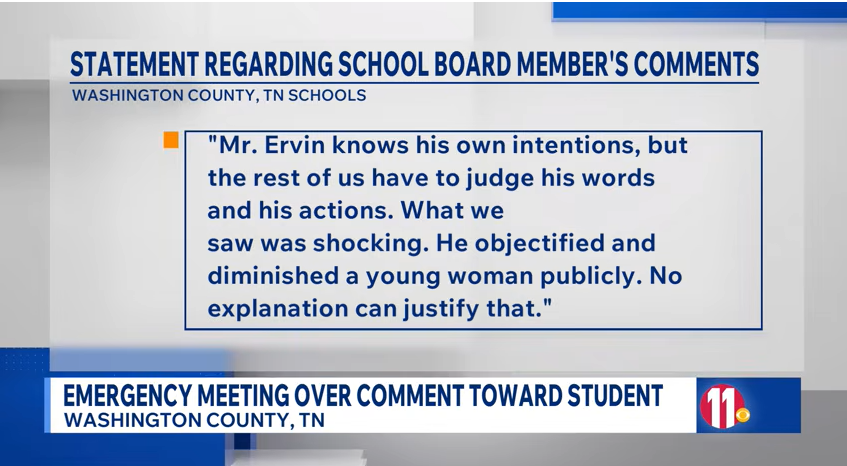
During a livestreamed meeting of the Washington County Board of Education on April 2, 2026, a high school student stood to speak about career and technical education programs at David Crockett High School. By all accounts, she did well—poised, articulate, and prepared. She did exactly what we hope students will do when we invite them into civic life: she showed up, did the work, and contributed meaningfully.
And then, seated beside her, board member Keith Ervin leaned in, placed a hand on her, and said words that have now echoed nationally and well beyond that meeting room: “God, you’re hot. Do you know that? Damn. Where do you go to school at?” Laughter followed. The meeting moved on.
It is here that any serious discussion must begin—not with spin, not with parsing intent, but with the simple reality of what occurred. A grown man, vested with public authority over a school system, directed a comment which many believe had an unmistakable sexual connotation toward a minor in a formal setting. That is not a close call. It is not a matter of partisan interpretation or cultural overreaction. It is a failure of judgment so basic that it undermines the very premise of public trust.
Ervin has since claimed that he meant “hot” as in “on a roll,” a compliment to the student’s performance. He apologized, noting that he is “not always good with words.” But language does not exist in a vacuum. Words carry meaning not only from dictionary definitions but from tone, context, and accompanying behavior. The inclusion of “God,” “Damn,” physical contact, and the immediate reaction in the room all point in one direction. To insist otherwise is not clarification—it is evasion.
And even if we were to grant, for the sake of argument, the most charitable interpretation imaginable, the standard for public officials—especially those entrusted with the welfare of children—cannot be reduced to “I didn’t mean it that way.” The standard must be higher. It must be conducted above reproach, not merely defensible after the fact. Some have criticized the Superintendent in this case; he works for the school board and does not have authority over the behavior of board members.
What followed only deepens the concern. The board convened an emergency meeting and voted unanimously to censure Ervin—a formal reprimand, yes, but one that carries no real consequence. He remains in his position. Calls for resignation—from fellow board members, including Whitney Riddle and Eric Barnes, and from thousands of citizens—have gone unheeded.
This points to a structural problem that extends beyond one man or one county. In Tennessee, as in many states, mechanisms for removing elected school board members mid-term are limited. Short of resignation or a court-ordered ouster, the remedy for misconduct often rests with the next election. That may satisfy the requirements of law, but it does not necessarily satisfy the demands of justice—especially when the conduct in question involves a student. The Tennessee General Assembly must address this issue once and for all by creating a process for removing elected officials. While we are at it, we should enact term limits for all state/local elected offices.
This failure is not an isolated incident. In 2009, Ervin was censured for entering a classroom at David Crockett High School and making a lewd gesture in front of students. At the time, he admitted to the behavior, describing it as an attempt to be “18 again.” Restrictions were placed on his presence in schools.
The recurring issue, both in the past and present, is not simply a one-time mistake, but rather a consistent failure—or refusal—to understand the boundaries that should regulate adult behavior around minors. Recognizing these patterns is important, as they influence not only our judgment of past actions but also our evaluation of potential future risks.
Some have raised a separate question in the wake of this incident: whether student representatives should sit on boards of education at all. It is a legitimate topic for debate. Reasonable people can disagree about the role students should play in governance, the benefits of their perspective, and the safeguards required to protect them. But let’s be clear: that debate has nothing to do with this case.
Even if one believes that student participation should be limited or reconsidered, there is no version of that argument that excuses what happened here. The presence of a student on a public board does not lower the standard of adult behavior—it raises it. It requires heightened awareness, greater restraint, and a clear commitment to professionalism. There is, in other words, no gray area to hide in.


At its core, this incident revolves around the meaning of authority. School board members, as public officials, are not just policymakers; they are also guardians of trust. When they serve on an education board, this trust carries even greater significance, as it pertains to children and families who justifiably expect a safe and respectful environment. They can also address this matter by putting it into the Board Policy. If a Washington County teacher, administrator, or staff member had done this, they would have likely been terminated.
When the public trust is broken, the response must be more than procedural. A censure may satisfy the letter of governance, but it does not restore confidence. It does not reassure parents. It does not tell students that the adults in charge will protect their dignity.
Only accountability can do that. And accountability, in this case, would mean resignation. Not because the law demands it, but because the office does.
JC Bowman is the Executive Director of Professional Educators of Tennessee and Contributing Editor to TriStar Daily.
Author