The Second Amendment Was Not a Theory. It Was a Memory.
The Second Amendment is usually argued on abstract grounds. Conservatives reach for the text. Progressives reach for the history of mass shootings. Both sides argue about what the Founders intended. Almost nobody asks the prior question: what kind of country did the Founders actually live in, and how did it differ from the places they had broken away from?
The answer changes everything about the debate.
When the Second Amendment was ratified in 1791, it was not written by men theorizing about liberty. It was written by men who had actually lived on the edge of a continent where an unarmed family was a dead family. The frontier experience was not a metaphor. It was a daily material reality.
A British or French subject in 1791 lived in a settled, policed, law-ordered society where a firearm was largely unnecessary for survival. England had game laws stretching back centuries that effectively barred the vast majority of the population from owning or using firearms. Gun ownership in Britain was tightly regulated, politically controlled after the Glorious Revolution of 1689, and considered potentially dangerous in the hands of the wrong classes. The government actively suppressed widespread civilian gun ownership because an armed populace had been, within living memory, a precondition of revolution and rebellion.
Probate records examined across the colonies in 1774, weighted to represent the entire country, show that gun ownership among propertied white males ranged from 54 to 73 percent depending on region. Women in 1774 owned guns at rates exceeding what some revisionist historians had claimed men owned at any point in the colonial period. The guns that existed were, by the standards of the day, in working condition. The frontier did not allow for ornamental weapons.
The reason was simple. The settlers who pushed west of the established coastal settlements were not soldiers supplied by a government. They were farm families who had to solve their own problems. Bears did not wait for a constable. Cherokee war parties did not send advance notice. The family that could not defend itself did not last long enough to pass anything down. The rifle leaning by the cabin door was not a political statement. It was the same category of tool as the ax and the plow.
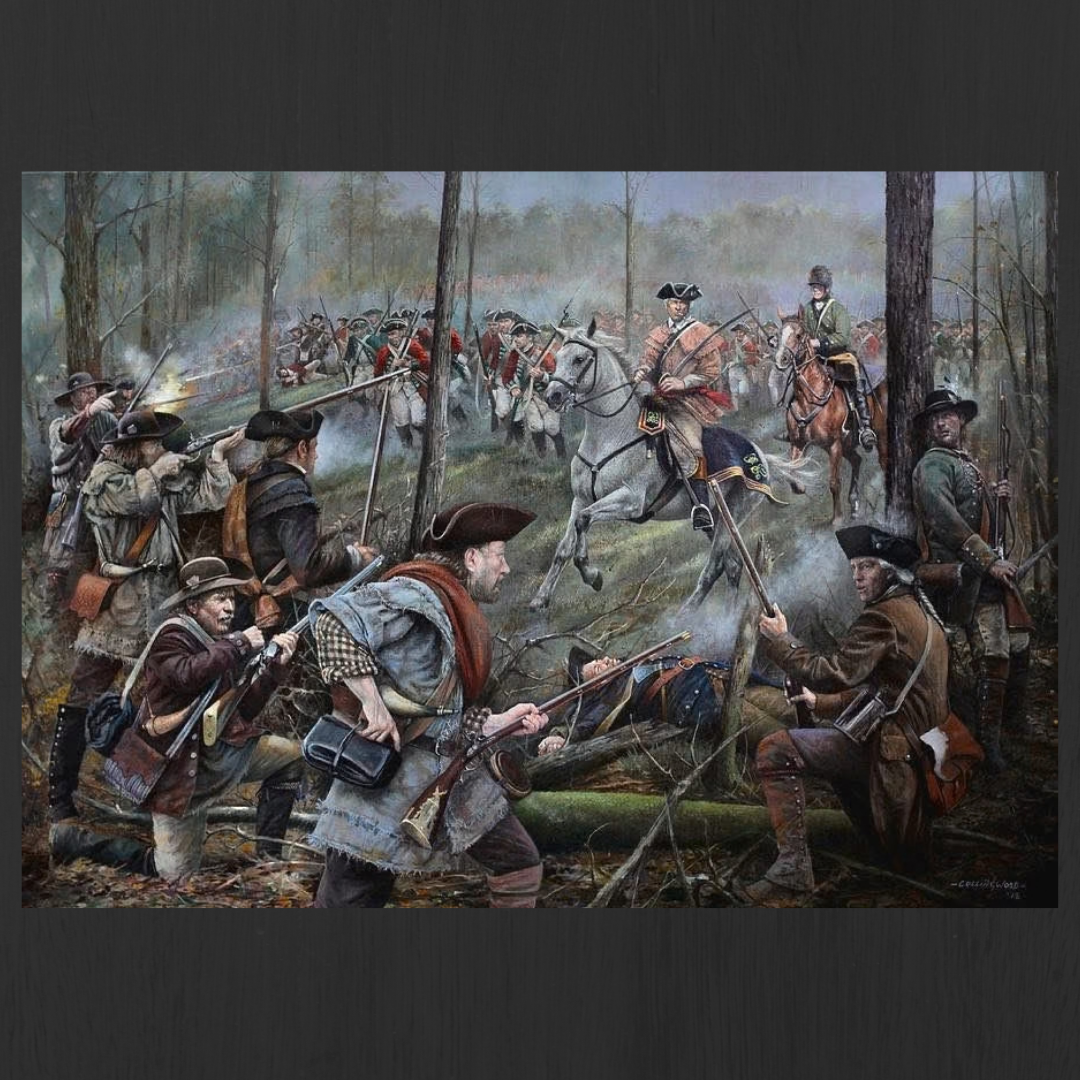
Nothing in American history illustrates this point more clearly than the men who fought at Kings Mountain on October 7, 1780.
The Overmountain Men were frontiersmen from the settlements west of the Blue Ridge in what is now Tennessee, Virginia, and western North Carolina. They were not soldiers. They had no supply train, no Continental Army authorization, and no formal military structure. They were backcountry farmers and hunters who had spent years not volunteering for the revolution, because their lives on the frontier were consuming enough without marching to distant battlefields.
Then Major Patrick Ferguson, one of the best marksmen and most capable officers in the British Army, made a mistake. He sent a message into the overmountain settlements threatening to march his army over the mountains, hang their leaders, and lay their country waste with fire and sword if they did not surrender. Isaac Shelby rode forty miles to consult with John Sevier. They decided it would be better to go meet Ferguson on his side of the mountains than to wait for him on theirs.
What happened next is worth sitting with. Approximately 1,400 men assembled at Sycamore Shoals with their own rifles, their own horses, and cattle they drove along as a food supply. They hiked over Roan Mountain in early October snow, covered roughly 200 miles in ten days, and surrounded Ferguson’s force of about 1,100 Loyalists atop Kings Mountain. The battle lasted one hour and five minutes. Ferguson was shot from his horse by riflemen who could hit a man at 200 to 300 yards. Over 200 Loyalists lay dead. The Patriot victory was so complete that it halted Cornwallis’s entire southern strategy and set in motion the chain of events ending at Yorktown.
The British Army brought muskets. Muskets were the standard military weapon of the era, smooth bored, capable of being fired three times a minute, effective at roughly 100 yards. The Overmountain Men brought hunting rifles. Rifles were slower to reload, but accurate at two to three times the range of a musket. The frontier had not been a place where inaccurate weapons served you well. The men who fought at Kings Mountain were skilled with their weapons because their weapons were part of their daily lives, not equipment checked out from a government armory.
This is the Second Amendment in its historical setting. Not a philosophical document. A description of what had already happened. Armed citizens, with weapons equivalent to those carried by the military, had just won a pivotal battle of the American Revolution entirely without the Continental Army’s knowledge or involvement.
If the founding era provides the affirmative case for armed citizenship, the 20th century provides the cautionary one. It is the bloodiest century in recorded human history, and the pattern embedded in its worst atrocities is not subtle.
Mao Zedong’s first act after consolidating control of China in 1949 was confiscation of all civilian firearms, a policy he had been implementing province by province since 1935. Anyone found with a gun after confiscation was executed. What followed was the death of an estimated 65 million people through execution, imprisonment, engineered famine, and political terror during campaigns like the Great Leap Forward and the Cultural Revolution. Mao understood the relationship between weapons and power. Political power, he said, grows out of the barrel of a gun, which is why he made certain that no one in China could access that power except through the Party.
Stalin’s Soviet Union followed a similar arc. The Bolsheviks conducted mass gun confiscation during the Russian Civil War, threatening ten years of imprisonment for anyone who concealed a firearm. Only Communist Party members were permitted to own weapons. What followed was the death of roughly 20 million Soviet citizens under Stalin alone, among the estimated 29 million killed by Soviet government across its history.
The Hitler case is more complex and worth getting right, because the honest version is actually more damning than the simplified one. The Weimar Republic had passed strict gun registration laws in the 1920s, and when the Nazis came to power, they used those registration lists to identify and disarm Jews, political opponents, and anyone else classified as an enemy of the state. They actually loosened gun restrictions for the broader German population, understanding correctly that the threat to their power did not come from ordinary Germans but from the specific populations they intended to liquidate. The Weimar gun registry became the tool by which Jewish families were stripped of any means of resistance before the machinery of the Holocaust was set in motion.
The lesson from Germany is not merely that gun confiscation enables genocide, though it does. It is that gun registration enables selective disarmament, and selective disarmament enables targeted extermination. The people who most need the Second Amendment have historically been the people that some government most wanted to disarm.
Pol Pot’s Khmer Rouge enforced total disarmament of the Cambodian population as one of its first acts upon seizing power in 1975, confiscating firearms along with watches, motorcycles, and foreign currency during the initial days of the takeover. Nearly 2 million Cambodians died in the years that followed. Idi Amin restricted weapons to his own loyalists in Uganda and used that monopoly on force to terrorize rivals and ethnic minorities throughout his reign.
The pattern is not a coincidence. It is a policy. Every government that set out to murder significant portions of its own population understood that it needed to remove the practical capacity for resistance first. You cannot load people onto cattle cars if a meaningful fraction of them can shoot back.
The Iran Lesson: 90 Million People, Zero Leverage
This is not purely a historical argument. The evidence is being updated in real time.
Iran has roughly 90 million people. The Islamic Republic has ruled them for 47 years through the machinery of the IRGC, the Basij militia, and systematic political terror. The regime tortured dissidents, executed political prisoners, sent teenage boys across minefields in the Iran-Iraq War, funded terrorist organizations across the region, and for nearly five decades answered every protest movement with lethal force.
When Mahsa Amini died in custody in 2022 and millions of Iranians took to the streets, the protesters threw rocks and Molotov cocktails. They were shot. The regime held.
Iran’s 1991 Firearms Law created a licensing regime so restrictive that civilian gun ownership is effectively limited to regime loyalists and a small number of hunters willing to navigate a bureaucratic obstacle course. According to Small Arms Survey data, Iran has roughly 7 civilian firearms per 100 people. The United States has approximately 120 firearms per 100 people, which means America has more guns than people.
Think about what that number means in concrete terms. Tennessee has about 7 million people. If Tennessee’s civilian gun ownership rate reflected the national average, Tennesseans possess well over 8 million firearms. The entire population of Iran, 90 million people, has fewer civilian firearms than a state with less than a tenth of their population. They have fewer than any fellow Tennessean’s immediate circle of neighbors, to say nothing of the pistols and hunting rifles and shotguns and everything else sitting in gun safes and closets and truck cabs across the state.
When the United States and Israel launched Operation Epic Fury on February 28, 2026, and began systematically decapitating the Iranian regime, those 90 million people had essentially no capacity to participate in their own liberation. They could watch. They could hope. They had no practical means to accelerate the end of the people who had been oppressing them for nearly five decades. The most powerful military in the world had to do for them what an armed population might have been able to begin doing for itself.
The Founders did not write the Second Amendment because they were worried about deer. They wrote it because they had just watched what happened to an unarmed colonial population under a government that decided it knew better than the people it governed. They had also just watched what an armed population could do about it. Both lessons were fresh.
The Objection Worth Taking Seriously


The honest critic will say: a population of civilians with hunting rifles and pistols cannot resist a modern military. Tanks, aircraft, artillery, and professional soldiers would overwhelm any civilian resistance. The Warsaw Ghetto Uprising in 1943 was crushed in weeks, and that was against a German military already strained on two fronts. What realistic deterrent value does an armed civilian population provide against a truly determined government?
This is the strongest version of the counterargument, and it deserves a real answer rather than dismissal.
The answer is not that an armed population guarantees victory against a tyrannical government. It does not. The answer is that an armed population changes the political calculus that produces tyrannical governments in the first place, raises the cost of each step toward totalitarian control, and provides friction at every stage of a process that requires a population’s practical helplessness to complete.
Regimes do not typically move from constitutional government to genocide in a single step. They move through intermediate stages of registration, selective enforcement, targeted disarmament of specific groups, and escalating coercion. An armed population is not a guarantee against any of those steps. It is a complication at every one of them.
Consider also the specific dynamic the Founders had in mind: not a population resisting an invading army on a conventional battlefield, but citizens resisting a government that had grown tyrannical from within.
The British Army was not an alien invader. It was the government of the colonists. The Overmountain Men were not facing tanks. They were facing the same category of infantry weapon they themselves carried, in roughly equal numbers, with the advantage of knowing the terrain and having personal stakes in the outcome. That is precisely the condition the Second Amendment was designed to preserve.
No one argues that a Winchester deer rifle is a practical match for an M1 Abrams. The argument is that a country where hundreds of millions of civilians are armed is a country where the intermediate steps toward tyranny are politically and practically harder to execute. Gun confiscation requires compliance. Selective disarmament requires a registry. Both require a population that will not shoot back. The Second Amendment is designed, among other things, to ensure that the answer to that last requirement is not guaranteed.
The argument for the Second Amendment is not sentimental. It is not about rural culture or hunting traditions or constitutional literalism, though all of those things are real. It is about a straight line that runs through American history and through the worst chapters of the 20th century and into the living reality of 2026.
The straight line is this: governments that murder their own people disarm them first. Not always. Not inevitably. But consistently enough that the pattern cannot be dismissed as coincidence. Mao disarmed. Stalin disarmed. Hitler selectively disarmed. Pol Pot disarmed. The Khamenei regime restricted civilian firearms to near zero while the IRGC and Basij maintained the monopoly on force that allowed them to rule 90 million people through terror for nearly five decades.
The American Founders did not write the Second Amendment because they were paranoid. They wrote it because they had read history, and because they had just lived through an experience that confirmed what history taught them. They were men who understood that governments are made of human beings, and human beings given unchecked power reliably abuse it, and that a population that cannot resist provides no practical check on that abuse.
The Overmountain Men who crossed Roan Mountain in the October snow of 1780 did not do so because of a constitutional right. They did it because they were armed, they were skilled, and a British officer had threatened their families. The Second Amendment was written eleven years later partly to ensure that the conditions which made that possible would not be allowed to disappear.
They were right to write it. The 20th century proved why. Iran proves it still.
Clayton Wood is a Knoxville lawyer, pastor and Contributing Writer for TriStar Daily.