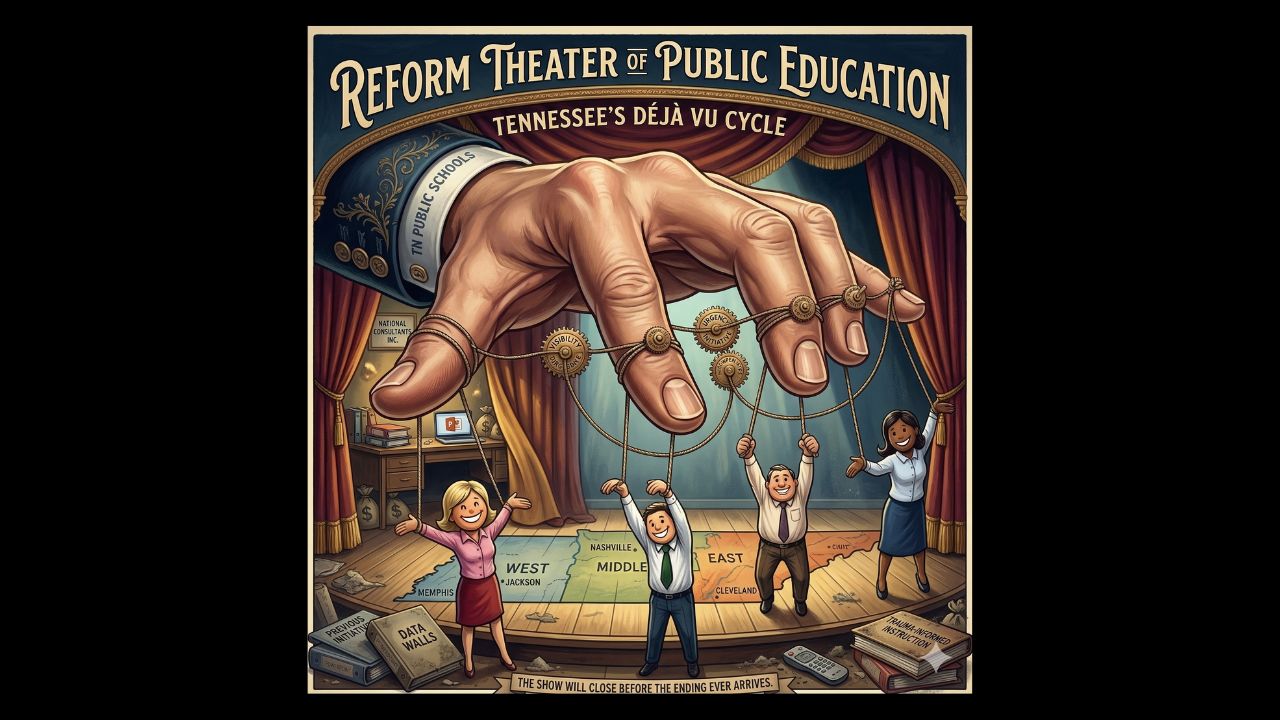
Spend enough time around public schools in Tennessee, and you notice a peculiar kind of déjà vu. The names change. The binders get thicker or thinner. The PowerPoints get sleeker. But the feeling—the sense that something sweeping and urgent has arrived to fix everything at once returns with the regularity of seasons.
Ask a veteran teacher—from Memphis to Cleveland to any small county system —what initiatives they have lived through, and you won’t get a list so much as a sigh. They’ve implemented data walls, personalized learning, trauma-informed instruction, and restorative discipline. Each arrived as the answer. Each required training, compliance, and belief. Most were eventually replaced or quietly set aside—often with state policymakers championing the next change.
The problem isn’t fickle teachers or some convenient bogeyman. It’s the system itself. It doesn’t reward steadiness. It rewards motion.
We have built an educational culture where leadership is judged not by what is sustained, but by what is launched. A new superintendent must signal direction. The principal must prove urgency. The easiest way to do both is to announce something new. Rebrand what exists, import a framework, unveil a plan that sounds like progress. In that kind of system, doing something well over time can look suspiciously like doing nothing at all.
Call it reform theater. The sets change. The actors rotate. And the audience—teachers, students, parents—learn to sit through it with polite endurance. Because they know, even if they don’t say it out loud, the show will close before the ending ever arrives. But theater alone doesn’t explain the cycle. There is also a business behind the curtain—and it is big business.
Much of it operates far from local classrooms. National organizations, consultants, and vendors—often backed by philanthropic dollars and lobbying muscle—package ideas and move them quickly into policy and practice. Education has become a marketplace of solutions: curriculum packages, professional development, software platforms, coaching models—each promising transformation, each ready for adoption.
The barriers to entry are low, the language persuasive, and the need real. If you can plausibly claim to help children, doors open quickly. If you can influence policymakers, they open faster, especially with a campaign contribution.
And once inside, the incentives are clear. No company profits from a school deciding, “We’re going to keep doing what works.” Stability doesn’t require contracts. Mastery doesn’t need rebranding. Fidelity to a proven approach is hard to package and sell. So, the system tilts toward novelty. Not always cynically. Often sincerely. But unmistakably.
Layer onto this a moral urgency that is both admirable and destabilizing. Educators are not manufacturing widgets; they are shaping lives. If a new idea might help a struggling reader in Jackson, Nashville, or a child in rural East Tennessee, the pressure to act is immediate. Waiting feels like neglect. Trying something new makes us feel like we care. And so, we act. Again, and again.
What gets lost is the cumulative impact on the classroom. Constant change doesn’t live in theory. It shows up in student behavior, teacher fatigue, and the fragile rhythm of a school. When expectations shift and systems reset, consistency erodes. Disruptions rise. Teachers lose the continuity that makes good instruction possible, and many eventually leave. New teachers step in, often underprepared, inheriting instability instead of structure. The state’s answer is not to address the real issue. And they are searching for anyone willing to teach in our classrooms.
Students feel it most. Those ready to learn lose time in classrooms where routines no longer hold. Too often, policy tilts toward managing disruption rather than preventing it, leaving teachers to juggle competing priorities that make sustained learning harder for everyone.
Real improvement rarely looks like a breakthrough. It looks consistent. It is a strong curriculum taught well, with teachers growing in their craft, and classrooms where expectations are clear and routines are consistent. None of them is flashy. None of them make headlines. And all of it is fragile. We don’t highlight those stories in the media.
Because just as it begins to work—just as a school finds its footing—the cycle resets. A new leader arrives. A new initiative rolls out. A new vendor makes a compelling pitch. And the quiet gains of sustained effort are disrupted in the name of visible progress.
This isn’t inefficiency. It’s alignment. The system is behaving exactly as it was designed to behave.


We reward leaders for change, not restraint. We fund programs, not persistence. We celebrate innovation, but rarely maintenance. And we have built an ecosystem that depends on the next adoption cycle. None of this means change is bad. Some reforms are necessary. Some ideas deserve to spread. Education should evolve as we learn more. But not all changes are improvements. And not all stability is stagnant.
There is a difference between a system that learns and one that forgets. Too often, we lean toward the latter—discarding practices before we understand them, layering new ideas without coherence, and mistaking activity for achievement.
If we are serious about improving schools in Tennessee, we will have to do something that feels almost radical: learn how to stay. Stay with what works long enough to see its full effect. Stay with teachers as they build expertise. Stay with systems that are showing results, even if they lack the shine of the next big thing.
And we must redefine leadership. Not the unveiling of the new, but the protection of the good. Not the constant pivot, but the steady hand. Not reform as performance, but as practice.
Because the truth, however unglamorous, is this: schools don’t improve because of what we start. They improve because of what we sustain. Until we learn to value that, the show will go on.
Author