By: Clayton Wood, Contributing Writer
I want to write carefully about police violence, accountability, and how these issues are discussed nationally and here at home in Tennessee..
I am a conservative attorney. I am often accused of being reflexively pro police. At the same time, I have written more consistently and more substantively about police use of force than many local politicians and activists who claim this issue as a core passion. I will let readers decide what to make of that.
What I am asking for in this series is not agreement. It is intellectual honesty.
This is not a simple issue. Anyone who claims it is usually has an agenda.
Here is a basic reality that has to be acknowledged.
Being a police officer is dangerous work. Officers regularly deal with people who are desperate, unstable, intoxicated, suicidal, violent, or some combination of all of the above.
Suicide by cop is real. It is tragic. And over the last couple of decades in Knox County, a heartbreaking number of police shootings fall into that category. People deliberately confront officers with weapons or weapon like objects, refuse commands, escalate situations, and force officers into life or death decisions.
There are many cases where a suspect points a gun at officers and is killed after attempts at de escalation. Where a suspect opens fire on police and is killed in return fire. Where a suspect charges officers with a knife or hatchet. Where a suspect attempts to kill officers with a vehicle. Where a suspect aims what later turns out to be a pellet gun. Where a suspect violently assaults officers with a blunt object capable of causing death. Where a suspect fires a weapon during a school incident and is killed in response.
In most of these cases, very few reasonable people object to the outcome. Officers are allowed to defend themselves and others from imminent threats of death or serious bodily injury.
Where things start to break down is in the public conversation.
Debate collapses into slogans.
On one side, people argue as if it is acceptable to shoot an unarmed person for trespassing but unacceptable to shoot someone who strikes an officer with a car.
On the other side, some people respond to every death with comments like should have complied or play stupid games win stupid prizes, as if non compliance itself were a capital offense.
Both of those approaches are wrong.
The law does not ask whether someone was good or bad. It asks whether deadly force was justified.
People often talk about good shoots and bad shoots. Those are informal phrases, but they point to real legal distinctions.
A lawful use of deadly force depends on whether a reasonable officer, under the totality of the circumstances, believed there was an imminent threat of death or serious bodily injury to the officer or others, and whether deadly force was necessary to stop that threat.
A shooting can be unjustified even if the person killed was committing a crime, resisting arrest, or behaving badly.
It is also important to understand that department policy, civil liability, and criminal guilt are not the same thing. Something can comply with policy and still be civilly wrongful. Something can violate policy and still not be criminal. These are different questions with different standards.
Tennessee played an important role in shaping this law.
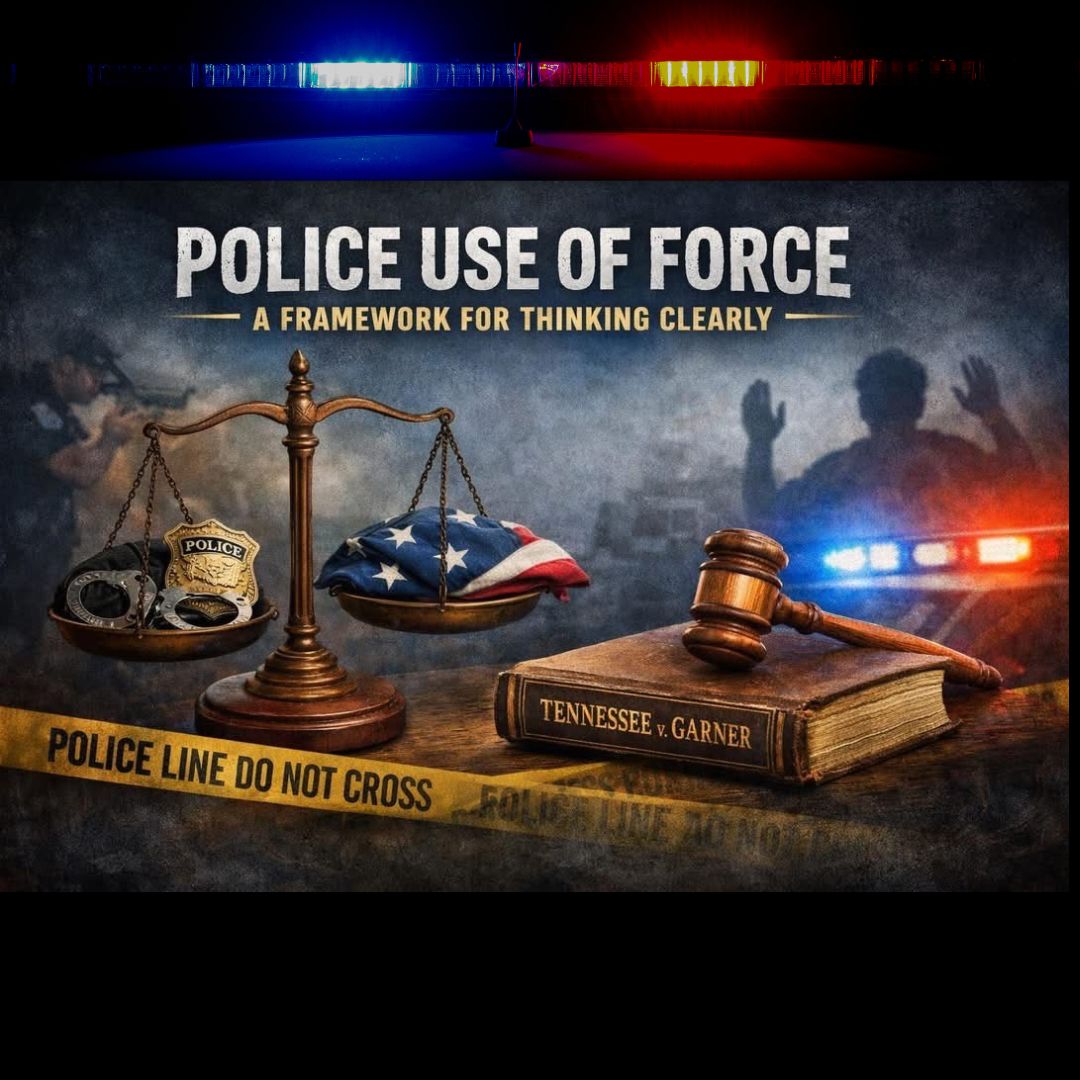
In Tennessee v. Garner, the Supreme Court made clear that police cannot use deadly force simply to prevent escape. Deadly force against a fleeing suspect is only justified if the officer has probable cause to believe the person poses a significant threat of death or serious bodily injury to the officer or others.
That principle matters in many modern cases involving foot pursuits, vehicles, and suspect flight.
Most people agree on the easy cases. The harder ones are where clear thinking matters most.
What about an unarmed suspect wrestling with an officer and landing punches. A suspect driving away from police with officers stepping into the path of the vehicle. An officer jumping into the bed of a truck and shooting as it drives away. A person dying after being restrained on the ground and unable to breathe. A person dying after repeated taser use. A person dying during an arrest where police later attribute death to a medical condition.


These cases cannot be resolved with slogans.
In the next post, I am not going to offer final answers or run through a checklist. I am simply going to name a number of Knox County incidents that fall into this harder category and link to publicly available reporting.
Many involve police use of deadly force or in custody deaths that most residents have never heard about.
Some were covered briefly. Some were framed in ways that minimized scrutiny. Some received little to no attention at all.
I am not asking you to reach a particular conclusion. I am asking you to notice something.
Many people who speak passionately about police violence said nothing about these cases. Some still say nothing.
And yet they spoke loudly about a recent case in Minneapolis where a woman struck a police officer with her vehicle and was shot.
If police violence is a core moral concern, that silence is worth noticing.
The same standards should apply to everyone. Accountability should not depend on politics, identity, or media usefulness.
That is not anti police.
That is pro-law, pro-truth, and pro-legitimacy.
Clayton Wood is a Knoxville attorney, pastor, and Contributing Writer for TriStar Daily.