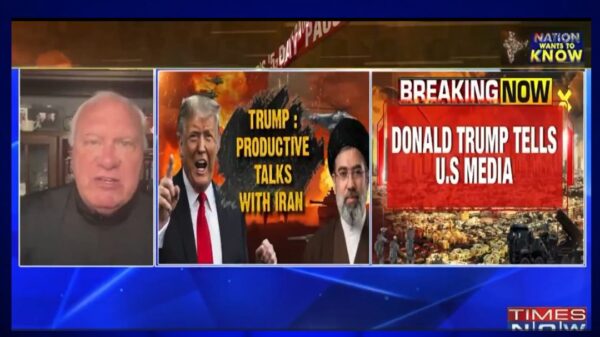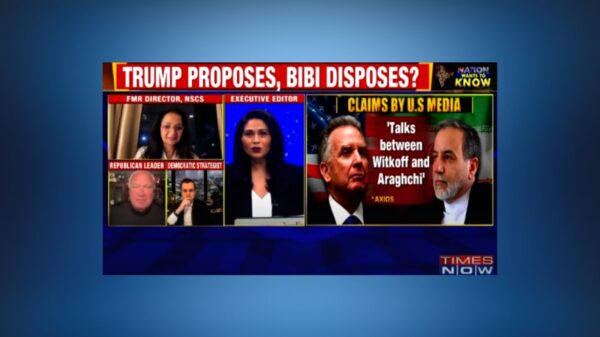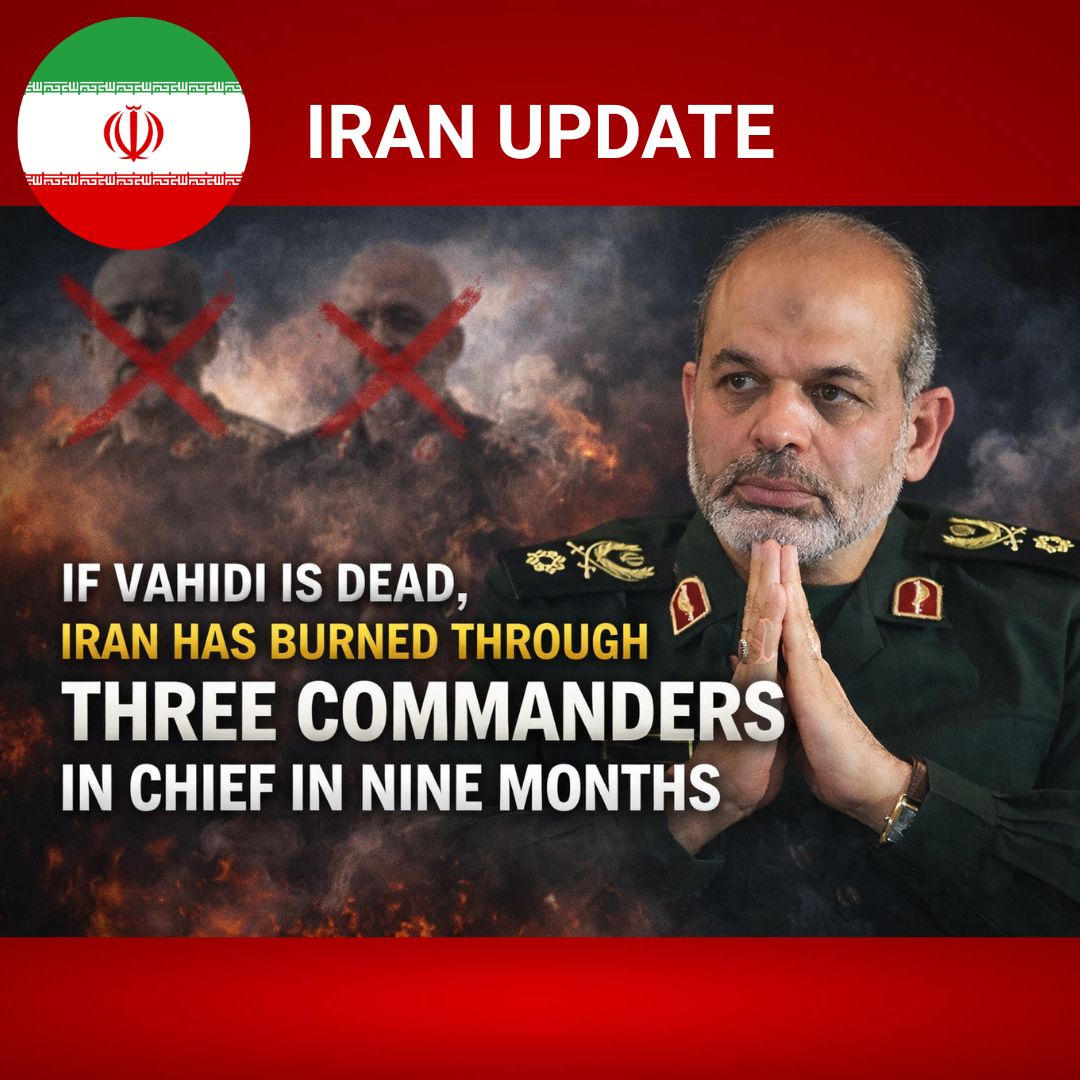
Breaking reports on X, as yet unconfirmed by CENTCOM, the IDF, or any major wire service, claim that Ahmad Vahidi, the current commander in chief of the IRGC, has been killed in overnight strikes. Official confirmation is still pending as of this writing. I am treating this as what it is: a credible unconfirmed report in a war where the confirmed reports have already been extraordinary enough that nothing should surprise anyone.
Let me tell you why it matters if true, because the pattern is the story regardless of whether this particular report holds up in the next few hours.
Hossein Salami ran the IRGC from 2019 until June 2025, when Israel killed him in the opening strikes of the Twelve-Day War.
Mohammad Pakpour replaced him. Pakpour was killed on February 28, 2026, day one of Operation Epic Fury, in the same opening wave that killed the Supreme Leader, the chief of staff, the defense minister, and the security council secretary. Vahidi was named Pakpour’s replacement on March 1. He had been a deputy commander for roughly two months before being thrust into the top job in the middle of a war that was already killing everyone around him. If the reports of his death are confirmed, the IRGC will have cycled through three commanders in chief in nine months, during which the institution lost its Supreme Leader, its naval commander, its Basij commander, its security council secretary, its intelligence chiefs, and 92 percent of its large naval fleet.
There is no historical parallel for that rate of command attrition in a military institution that is still nominally functioning.
Pete Hegseth said publicly last week that the last job anyone in the world wants right now is a senior IRGC leadership position. The Times of Israel reported in mid-March that Vahidi was not even in the IRGC’s top ten until December, when he became deputy chief. He was elevated to the top job because everyone above him was already dead. The man brought in to stabilize the institution, who was himself a fallback option after the primary candidates were eliminated, is now reportedly gone too.
That is not a decapitation campaign anymore. That is systematic institutional destruction. The body of the IRGC still exists. There are still soldiers, still missile sites, still launch capability. The Khorramshahr cluster barrages reaching Tel Aviv confirm that. But the people who coordinate complex operations, who approve targeting, who manage the command cycle between launch authorization and execution, are being removed faster than they can be replaced with anyone who knows what they are doing. What remains is an institution that can still pull triggers. It is losing the ability to decide which triggers to pull, when, and toward what strategic end.
The Admiral and the General: Two Days, Two Commands Gone
Even before the Vahidi reports broke, the last 48 hours had already produced the most significant command losses since the opening of the war.
Admiral Alireza Tangsiri, who built and led the IRGC Navy since 2018 and personally designed the mining operations that closed the Strait of Hormuz, was killed in Bandar Abbas on the night of March 25. CENTCOM confirmed it.
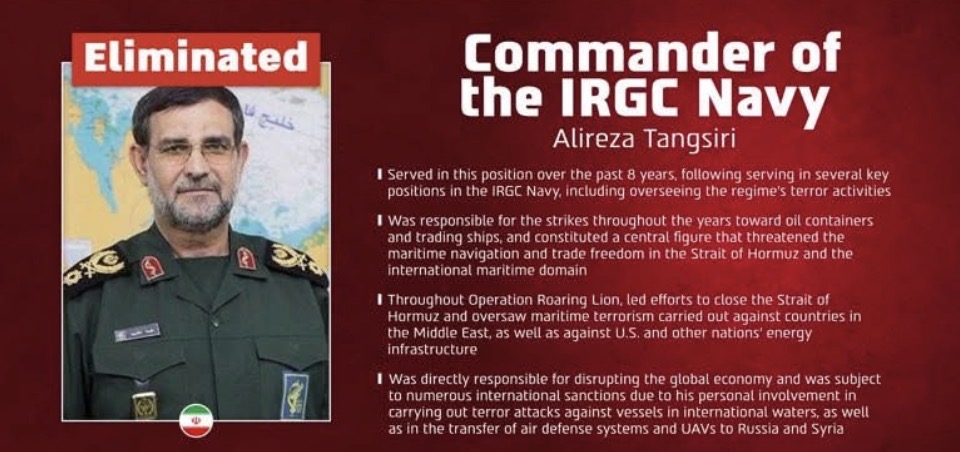
Netanyahu confirmed it on camera. The IRGC Navy’s intelligence chief, Behnam Rezaei, was killed in the same strike. Admiral Brad Cooper of CENTCOM followed with a direct message to every surviving IRGC sailor: abandon your post and go home, or face the same outcome. That is not diplomatic language. That is a military institution publicly informing its opponent’s enlisted ranks that their chain of command no longer exists in any meaningful form and that remaining in place is a death sentence rather than a military duty.
Tangsiri had been on the US Treasury’s terrorist designation list since 2019. He was additionally sanctioned in 2024 for his role in drone development, specifically the Shahed systems that were being manufactured by a company he chaired and shipped to Russia for use against Ukrainian civilians. The man who closed the Strait of Hormuz was also arming the war in Ukraine. His death serves multiple theaters of American strategic interest simultaneously, and CENTCOM’s statement made no effort to conceal the satisfaction with which that observation was being made in Washington.
Now, if confirmed, the man who was supposed to rebuild the IRGC’s command structure from the top down is also gone.
The Nuclear Strikes and What They Tell You About the US-Israel Relationship
Today, while Trump’s extended deadline was still technically in effect, Israel struck two Iranian nuclear facilities. The IDF hit the heavy water plant at Arak and the uranium extraction plant at Yazd, which it described as the only facility of its kind in Iran where raw materials from mining undergo chemical processing before uranium enrichment. Iran’s foreign minister called it a direct contradiction of Trump’s diplomatic extension and threatened a heavy price for Israeli crimes.
That tension is worth understanding rather than dismissing. The United States and Israel are not running an identical clock. Trump extended the energy plant deadline. Israel did not extend its nuclear targeting campaign. Those are two different things, and the gap between them tells you something important about where each party’s core interest lies. For the United States the primary objective is an open strait and a denuclearized Iran achieved at the lowest possible cost in American lives and money. For Israel the primary objective is permanent elimination of Iran’s nuclear capability regardless of what diplomatic process is underway. Those objectives overlap substantially but they are not the same, and days like today make the seam visible.
Iran is now responding to a 15-point US proposal with its own five conditions. One of those conditions is formal recognition of Iranian sovereignty over the Strait of Hormuz. That claim is not a negotiating position. It is extortion codified as diplomacy, and it tells you which factions inside what remains of the Iranian government are still driving the response. The Iranian parliament is simultaneously drafting legislation to formally codify toll collection from ships transiting the strait, treating an international waterway as a revenue source the regime owns by right of geography. Today, March 27, Iran also successfully blocked two Chinese ships attempting to enter the strait. The closure is still active. The regime’s position on that closure has not moved.
This Is Not TACO. Understand What Trump Is Actually Holding.
The extension of the deadline to April 6 is being called weakness by the same media complex that has been wrong about every major development in this war for four weeks running. That characterization is not analysis. It is a narrative looking for evidence and not finding any.
What Trump extended is a naval bombardment campaign that would sanitize the entire southern Iranian coastline, destroy every remaining coastal defense within operational range of Kharg Island and the shipping corridor, and set the conditions for what the Marines who are pre-staging in the region are there to do. That is not a gentle diplomatic courtesy. That is the most destructive phase of this conflict held in reserve, available to be executed on ten days’ notice, while the other side decides whether they want April 6 to arrive or not.
Every day of that extension, Iran’s command structure gets thinner. Every day, the economic pressure inside a country whose soldiers are reportedly going without pay compounds. Every day, the factions inside what remains of the Iranian government who want to survive this have a stronger argument against the factions who want to keep fighting. Every day, the military position of the United States and Israel improves while Iran’s degrades. Extending a deadline when you are winning every day of the extension is not weakness. It is the oldest move in negotiation: giving the other side room to choose the cheaper option before you impose the expensive one on them.
Iran knows what April 6 means. The region knows what April 6 means. The markets know what April 6 means. The only people pretending not to know are the ones whose political interests are served by framing every Trump decision as a retreat.
Egypt and Pakistan Are Not on American Political Timelines
I have seen analysis that suggests the mediators have room to work because American midterm elections are still 200 days away. That analysis fundamentally misunderstands what is driving Cairo and Islamabad.
These governments are not operating on American electoral cycles. They do not have 200 days. They may not have 20.
Egypt raised domestic fuel prices 17 percent in a single emergency decree. The pound hit a record low. The government is not thinking about November. It is thinking about next month’s IMF review and next month’s bread prices and whether it survives next month’s street protests if those bread prices continue to rise. Pakistan is running emergency austerity on a four-day government work week while managing a nuclear arsenal and a population watching its purchasing power disappear in real time. Prime Minister Shehbaz Sharif did not offer Islamabad as a negotiation venue because he has diplomatic ambitions. He offered it because his government has a specific and near term date on which it runs out of runway.
When Cairo and Islamabad push Tehran, they are not delivering American messages. They are telling Iran what they need, in terms that the regime cannot dismiss as Zionist propaganda or American imperialism. They are Muslim governments with Muslim populations, under economic stress severe enough that failure is not an abstract policy outcome for them. It is a political survival question measured in weeks, not months. That is a different kind of pressure than anything Washington can generate directly, and it is running on a much shorter clock than American midterm politics.
Who Is Paying for This War and Who Is Getting Rich
Let me say this plainly because the financial media covers it without ever quite stating it directly.
Every day the Strait of Hormuz remains closed, commodity traders sitting at computers make money betting on how long it stays closed. Those bets price directly into what you pay at the pump. The cost to extract a barrel of oil or a unit of LNG has not changed since February 27. Production costs are flat. What changed is the price American energy companies can sell for, because a chokepoint is closed and the market is pricing in risk that a small number of people are getting very rich collecting. The spread between what it costs to produce and what a frightened market will pay is going directly to the bottom line of people who were already wealthy, and you are funding it every time you fill your tank.
You are paying a war tax you did not vote for. It ends the day the strait opens. Anyone who claims to care about working Americans and also cheers for this to drag on is telling you exactly where their loyalties are, and it is not with the person paying appreciably more than they were paying in January.
The downstream consequences are now showing up in real time around the world. The Philippines has declared a state of energy emergency with only 40 to 45 days of petroleum supply remaining. South Korea declared an emergency economic response. Japan is releasing oil from state reserves. These are American allies absorbing the cost of a closed waterway that the United States is bleeding to reopen while they make contingency plans rather than contributions.
The Free Rider Problem Is No Longer Abstract
This war has made visible something that has been true for decades but easy to ignore when it cost less.
Europe needs Middle Eastern energy far more than America does. Japan needs it. India needs it and has at least had the decency to send its navy to help. The Gulf states export it and their entire sovereign wealth model depends on those exports continuing to flow. Yet when the Strait of Hormuz is threatened, it is American carriers, American aircraft, American pilots running 6,000 combat sorties, and American taxpayers absorbing the cost of an operation that has destroyed 92 percent of Iran’s large naval fleet.
NATO has been almost entirely absent from this conflict. The alliance whose entire purpose is collective defense of the liberal international order, including the free flow of global commerce, has contributed essentially nothing to an operation that directly protects the energy supplies of its European members. That is going to have consequences for the alliance that are only beginning to be calculated, and those consequences should come sooner rather than later.
Today at the G7 Foreign Ministers meeting in Paris, Secretary of State Marco Rubio said publicly what I have been writing in these updates for weeks. He told allied foreign ministers that after this war ends, one of the immediate challenges will be Iran attempting to set up a tolling system on the Strait of Hormuz, and that while the United States is prepared to be part of the plan to confront it, it does not have to lead that plan. He said directly that the countries with enormous stakes in open international waterways should contribute greatly to that effort, naming not just G7 nations but countries across Asia. That is the free rider argument made at the G7 podium by the American Secretary of State. It is now official American policy, stated publicly, at the highest diplomatic level available short of the President himself. The question is whether it will be followed by a financing structure that matches the rhetoric, or whether it will evaporate the way these statements usually do once the immediate crisis passes.
The UAE Can Fund the Long-Term Solution. It Should.
I said this in my March 25 update and I will keep saying it until someone with the ability to act on it does. The long-term security of the Strait of Hormuz should not be an American charity project.
The UAE has the sovereign wealth and the strategic interest to build a durable security architecture for the strait that does not depend on permanent American garrisoning. What that looks like in practice is not complicated. A purpose-built interdiction navy focused on escort and rapid response. A drone-first air capability providing persistent coverage of the shipping corridor and Iranian coastal zones, with automated or near-automated response cycles tied to launch detection. Rapid strike systems positioned to punish any attempt to close or threaten the strait within minutes rather than hours. Pre-positioned logistics to sustain operations without relying on American supply chains.
This does not have to be a traditional national military in the conventional sense. Wealthy states contract security capabilities all the time. A modern equivalent of the Varangian Guard, highly trained, well compensated, technologically integrated, and laser focused on a specific mission, is not a fantasy. It is a financing and organizational problem, and the UAE’s sovereign wealth funds have solved larger ones.
There is a dimension of this that has not received enough attention. Ukraine right now has more real-world operational experience in drone warfare, including maritime drone operations, than almost any nation on earth. They have been improvising, iterating, and executing drone strikes under active combat conditions for years. That expertise does not have to stay in the Black Sea. There is no rule against contracting it, transferring it, or building on it in a different theater. A Gulf-funded force that incorporates Ukrainian drone doctrine and operational experience into a strait-focused security architecture would be one of the most cost-effective security investments in the region’s history.
The economic math is not complicated. The terror premium that has been added to every barrel of oil and every unit of LNG since February 28 represents an enormous ongoing cost to the global economy. A funded, persistent, professional security force capable of guaranteeing passage and punishing disruption immediately would compress that premium toward zero. The countries capturing the benefit of open strait transit, the energy exporters, the energy importers, the shipping companies, the insurers, would all pay less per unit of risk than they are currently paying through elevated commodity prices and war insurance costs. The force pays for itself many times over before it fires its first shot in anger.


The only question is whether the political will exists in Abu Dhabi to move from being a nation that benefits from American security provision to being a nation that funds its own security and shares the capability with willing partners. Given that Iran fired 357 ballistic missiles, over 1,800 drone attacks, and 15 cruise missiles at the UAE in this conflict, including strikes on the Palm Jumeirah, Dubai International Airport, and the Burj Al Arab, I would suggest that the answer to that political question has already been provided by the other side.
A Year From Now
I will repeat what I said in my last update because it bears repeating until it becomes policy.
I would be very surprised to see American troops garrisoned around Kharg Island a year from now unless someone is paying us to be there. Not contributing to a multilateral framework. Not promising future cooperation. Actually paying, in advance, for the ongoing cost of security provision in a region that has demonstrated it cannot or will not provide that security for itself.
America can secure the strait. America can reopen it. America can demonstrate, as it is demonstrating right now, that disruption will fail and that attempting it carries a price measured in dead admirals and dead commanders in chief. But demonstrating capability is not the same as permanently subsidizing security for other people’s exports at American taxpayer expense. The demonstration has been made. Rubio said at the G7 that the bill should follow. The question is whether it does.
The People of Iran Are Not the Regime
Something important is being consistently flattened in the coverage of this war.
When Khamenei died, Iranians went into the streets of Isfahan, Karaj, Kermanshah, Qazvin, and Shiraz to celebrate. Not in the diaspora. Inside Iran. In major cities. The regime calls every dead commander a martyr. The Iranian people who have been murdered, raped in detention, and disappeared for speaking too loudly have a different word for it.
The economic suffering inside Iran is not comparable to an American paying more to fill a tank. Iranian soldiers are reportedly going without pay. The currency has been in structural collapse for years, compounded by a government that treats the national treasury as a financing mechanism for proxy wars in Yemen, Lebanon, Iraq, Gaza, and Syria while its own population goes without. The middle class that existed before the Islamic Revolution has been systematically hollowed out over four decades by a government that needed poverty to maintain control.
303 American service members have been wounded in action since the start of combat operations, more than 75 percent with traumatic brain injuries, and 10 still seriously wounded. That is the cost on our side. Iran’s Red Crescent reports nearly 2,000 dead on theirs, with estimates from human rights organizations suggesting military casualties of several thousand more. These are real numbers involving real people and they deserve to be stated plainly rather than buried in a news cycle competing with itself.
The fifth column in America that is cheering for the regime’s survival is cheering for the people doing the murdering, raping, and disappearing. There is no nuanced framing that changes what that is.
There is also a consequence to the strait closure that extends beyond anything visible in today’s news cycle. Fertilizer cannot move out of the Arab states that produce and export it through the Gulf. That disruption does not resolve the day the strait reopens. It moves through agricultural supply chains over months, and it eventually lands as food price increases and shortages in parts of the world that can least absorb either. The regime that decided to close the strait will cause hunger far from Iranian borders, months from now, as a direct downstream consequence of decisions made in the last four weeks. That is who we are dealing with. That is who the apologists are running interference for.
Two Paths, One Destination
Here is the clearest frame I can offer for what the next ten days mean.
If the factions Trump can negotiate with prevail inside what remains of the Iranian government, the strait opens through agreement. American ground forces stay out of direct action in the corridor. The diplomatic path is cheaper in lives and in money, and it produces the same strategic outcome.
If those factions lose, the strait also opens. But it opens after 72 to 96 hours of bombardment that removes every remaining Iranian coastal defense within operational range of Kharg and the shipping lanes. It opens after Marine operations in conditions that have been specifically prepared for and pre-staged over the last several weeks. It opens at a higher cost in American lives and in the physical destruction of Iranian infrastructure, with worst case whatever remains of Iran’s energy export capacity reduced to rubble in the process.
Both roads end at the same destination. One is cheaper. The man who has to decide whether to take the cheaper road is, if the overnight reports are confirmed, no longer Ahmad Vahidi. It is whoever Iran can find to sit in that chair for the fourth time in nine months, inheriting a command structure that has been systematically emptied of everyone who knew how it worked.
The clock says April 6. Watch for confirmation on Vahidi. If it holds, the institutional story of the IRGC in this war is essentially complete. What remains is an armed force without a command, firing missiles from sites like Yazd because the muscle memory of the launch cycle outlasts the people who were supposed to direct it toward strategic ends.
That is not an army anymore. That is momentum. And momentum runs out.
Author