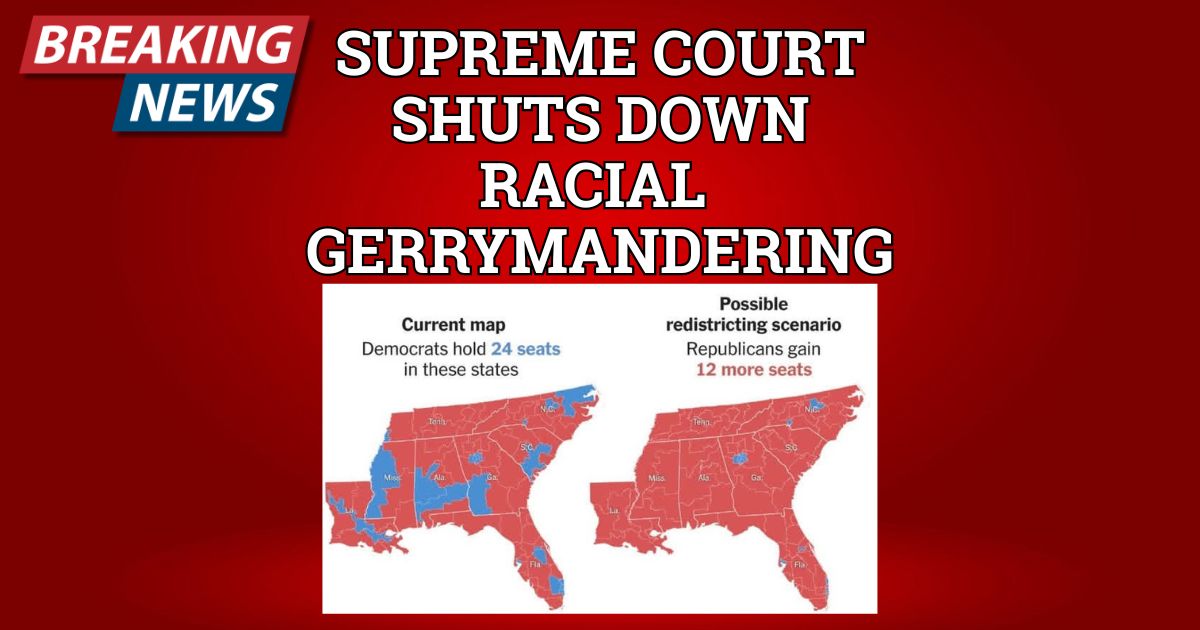

In a hugely consequential ruling on the Voting Rights Act (VRA), the U.S. Supreme Court held in a 6-3 decision that drawing congressional districts based on race is unconstitutional. The decision could lead to flipping as many as 14 to 19 seats from Democrat to Republican, mostly in the southern U.S.

The case, Louisiana v. Callais, was first argued last March before the Court and focused on whether Louisiana’s 2024 congressional map, which had added a second majority-Black district in the state, amounted to an unconstitutional racial gerrymander.
Despite many states drawing boundaries with the intent of ensuring blacks being elected to Congress based upon racial majorities producing race-based votes, majority black districts drawn under the VRA have sometimes resulted in non-minorities being elected, i.e., Democrat Steve Cohen in Memphis. And in majority-white districts, blacks have been elected, such as Rep. Byron Donalds in Florida, among others.


In response to the Court’s ruling, State Representative Johnny Garrett, who is running for Congress in the 6th District seat being vacated by John Rose, has called for a special session of the legislature to be convened to redraw the 9th District boundaries (Memphis). Tennessee currently has a 9-1 Republican advantage in the state’s congressional delegation.
Because the 9th District is in a corner of the state bounded by Arkansas and Mississippi, redrawing it to make it more Republican by pulling in a number of rural West Tennessee “red” counties would almost certainly trigger a domino effect across the entire state.


Additionally, republican Congress members always protest any changes that might leave their districts even marginally less tilted in their favor. 8th District GOP Congressman David Kustoff would be the member of the Tennessee delegation most immediately and negatively affected by any new map placing large numbers of Memphis Democrats into his overwhelmingly “red” district. The 4th, 5th and 6th districts would also likely be redrawn to accommodate the division of votes in the 9th.
The 9th Congressional District was not specifically drawn as a VRA district, GOP Chair Scott Golden notes, and the Supreme Court ruling does not strike down the VRA completely, they simply limited the ability to use racial focus in drawing lines. Nevertheless, he acknowledges that it creates a great opportunity for Republicans to redraw lines that will likely increase their numbers in Congress. “I haven’t seen any recent maps playing with prospective lines in expectation of dividing the 9th,” Golden acknowledged, “but I’m sure they are out there somewhere.”
Golden also pointed out that a state house district, District 80, encompassing part of Hardeman, Haywood, and Madison counties in West Tennessee, was specifically drawn with intent under the VRA. Representative Johnnie Shaw, the last remaining democrat representing a rural district in Tennessee, currently holds the 80th district seat. “I would certainly expect the legislature to focus on that seat when redistricting occurs, whether it’s through special session or after the 2030 census,” Golden said.
Mississippi Governor Tate Reeves has already issued a call for a special session to redraw congressional lines in anticipation of the Supreme Court ruling on the VRA.
Steve Gill is an attorney, editor, and publisher of TriStar Daily.